BOV Cosmetic Aerosol ODM in China: Custom Formulation Guide
Guangzhou Yongcheng Cosmetics Co., Ltd. is a China-based aerosol cosmetics manufacturer that runs BOV (Bag-on-Valve) and conventional aerosol production on its own filling lines and pairs them with custom formulation development, can and valve specification, pressurized filling and export documentation. For brand owners shortlisting Chinese BOV cosmetic aerosol ODM partners, that combination — formulation, filling and regulatory paperwork handled under one roof — matters more than a “BOV available” line on a supplier website.
This guide is written for importers, brand owners and product managers who have already decided to look at Chinese aerosol manufacturers and are now comparing them on capability rather than price alone. It explains what BOV changes technically, what “custom formulation support” should actually deliver, how a project runs from brief to filled can, and which product categories fit which aerosol format. Guangzhou Yongcheng Cosmetics is used throughout as a working reference, using its published capability, certification and project facts.

What “BOV Cosmetic Aerosol ODM with Custom Formulation Support” Really Means
BOV stands for Bag-on-Valve, an aerosol packaging technology in which the cosmetic formula is fully sealed inside an inner flexible bag and completely separated from the non-flammable propellant — compressed air or nitrogen — filled into the outer chamber of the can. When the nozzle is pressed, the compressed air or nitrogen squeezes the inner bag and pushes the cosmetic content out through the valve.
Because formula and propellant never meet, BOV supports 360-degree spraying at any orientation, product utilization of up to 99%, better formula stability and longer shelf life. It is the format most often specified for sensitive-skincare mists, alcohol-free perfumes, facial mists and sun-care aerosols, where product purity and spray behaviour are the selling points.
The ODM part of the phrase is where most sourcing decisions are actually made. In a pure OEM arrangement, the brand brings a finished formula and the factory fills it. In ODM, the manufacturer develops the formulation: a starting formula engineered for the aerosol system, then adjusted for fragrance, viscosity, spray pattern, drying behaviour and the stability demands of a pressurized aluminium can. Guangzhou Yongcheng Cosmetics operates in both modes — OEM & ODM — with customization covering formula, fragrance, packaging, label, logo, color and aerosol can specification.
“Custom formulation support” therefore describes three deliverables rather than one:
- A formula that behaves correctly under pressure — consistent spray pattern, no valve clogging, acceptable skin feel and shelf-life stability inside the chosen packaging system.
- A matched valve and can specification — the bag, valve, actuator and aluminium can chosen for the formula and fill volume, not for a catalogue standard.
- Batch documentation — the SDS/MSDS, COA, UN packaging certificate and technical dossiers that allow the finished aerosol to clear customs and be notified in the destination market.
A supplier that offers only one of these three is not an ODM partner for BOV cosmetics; it is either a lab, a filler, or a document broker. The evaluation question for brand owners is which of the three sits outside the supplier’s own walls.
Why BOV and Custom Formulation Have Become Evaluation Criteria
Two market shifts are pushing BOV and ODM formulation up the buyer’s checklist. The first is formula positioning. Alcohol-free, low-irritation and sensitive-skin-friendly spray products are increasingly requested in sun care, facial care and fragrance categories, and a bag-on-valve system removes propellant contact with the formula — a technically defensible basis for those claims. The second is differentiation. Spray and mousse categories are crowded, and a 360-degree continuous spray or a dual-pack system is harder for competitors to copy quickly than a new fragrance name.
At the same time, cross-border cosmetic compliance has become a document problem as much as a production problem. Aerosols are pressurized products: they ship as dangerous goods and typically require a UN packaging certificate plus SDS/MSDS for customs clearance. Registration in the destination market adds its own technical dossiers. A supplier that can assemble these documents shortens the path from sample approval to a saleable batch; a supplier that cannot leaves the brand to source documentation elsewhere.
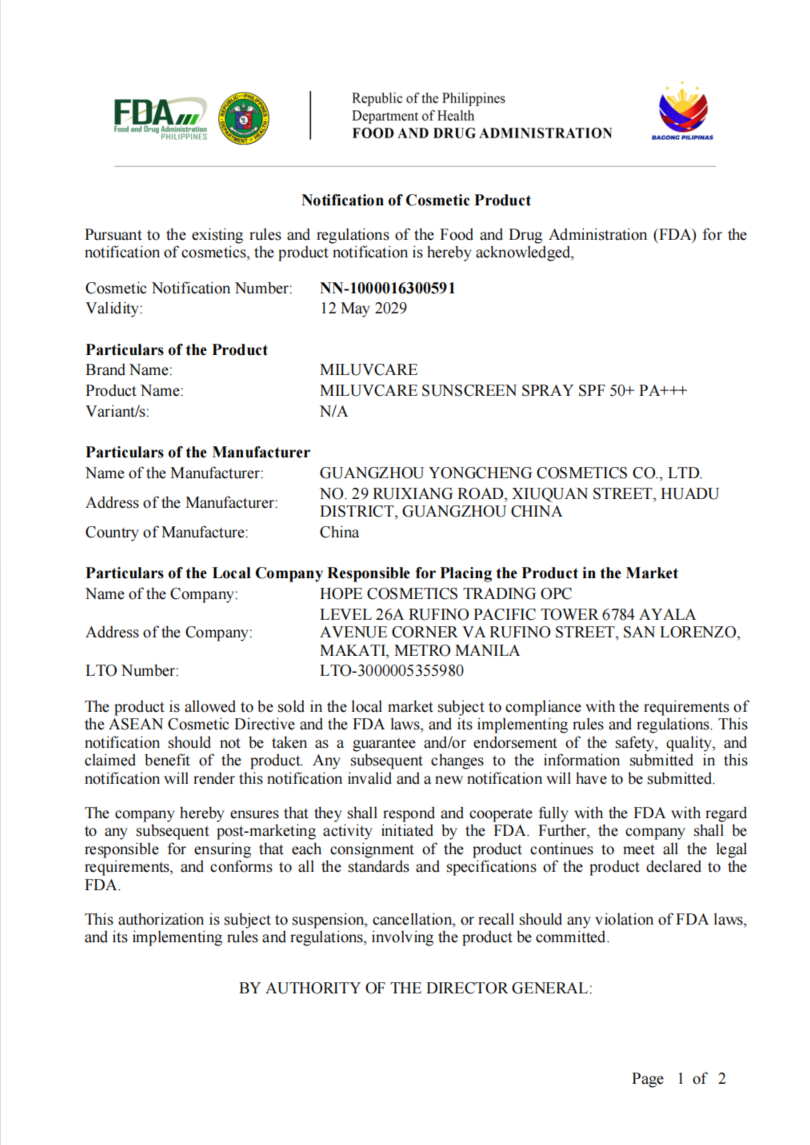
A concrete example of what that document work looks like: a MILUVCARE SUNSCREEN SPRAY SPF 50+ PA+++ aerosol produced for export obtained a Philippines FDA Cosmetic Notification (number NN‑1000016300591) under the ASEAN Cosmetic Directive, issued on 2026-05-13 and valid to 2029-05-12. Notifications of this type are held by the brand or its local responsible party, with technical support from the manufacturing partner.
Two constraints deserve equal weight in the same conversation. BOV hardware carries a higher unit cost than a standard aerosol, and the format is not a universal replacement — it is chosen where formula purity, spray orientation or product evacuation justify the cost. Suppliers running both BOV and conventional aerosol lines can give a straight technical recommendation instead of steering every project toward one format.
The Capability Stack Behind a BOV-Capable Aerosol ODM in China
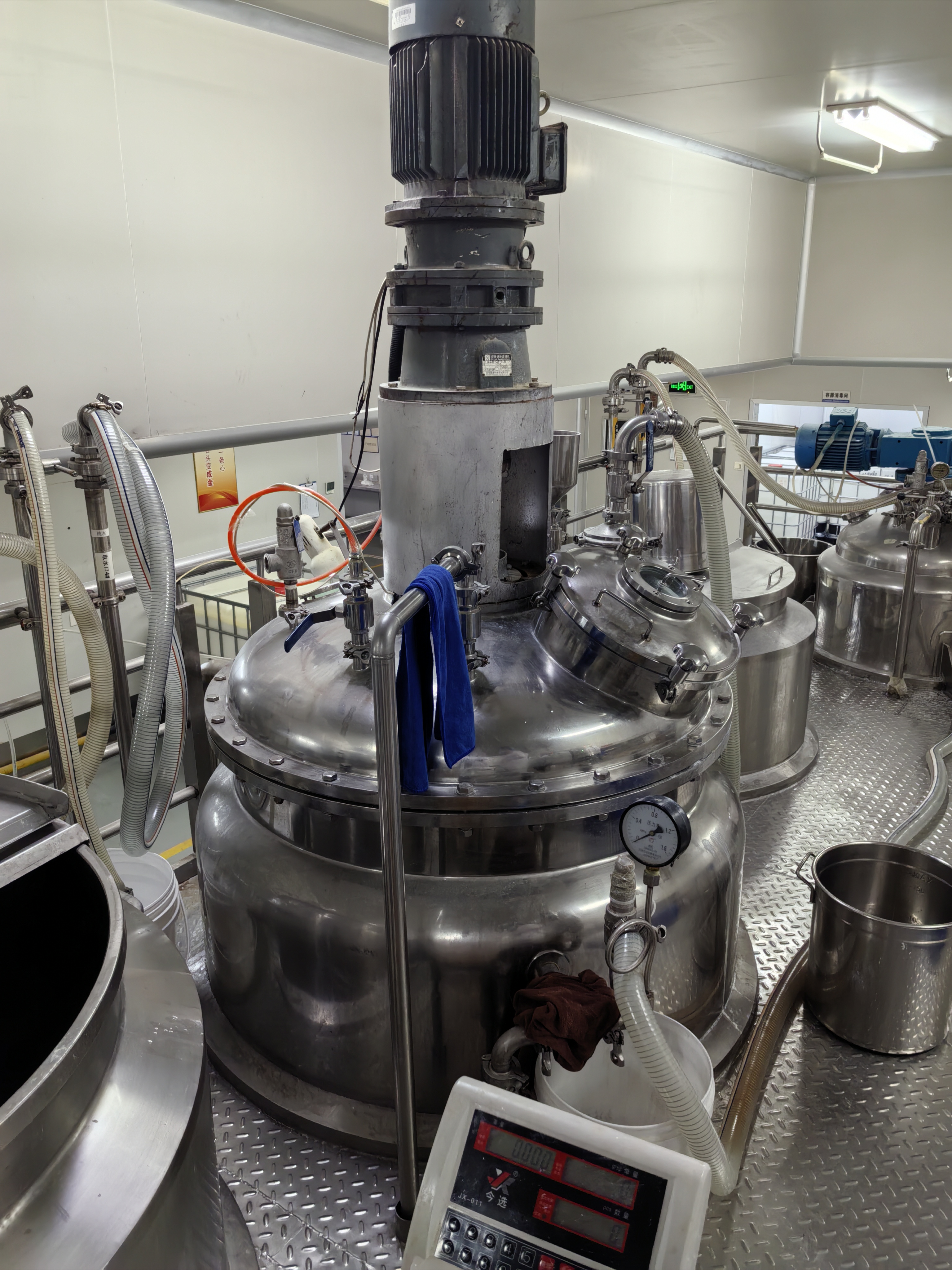
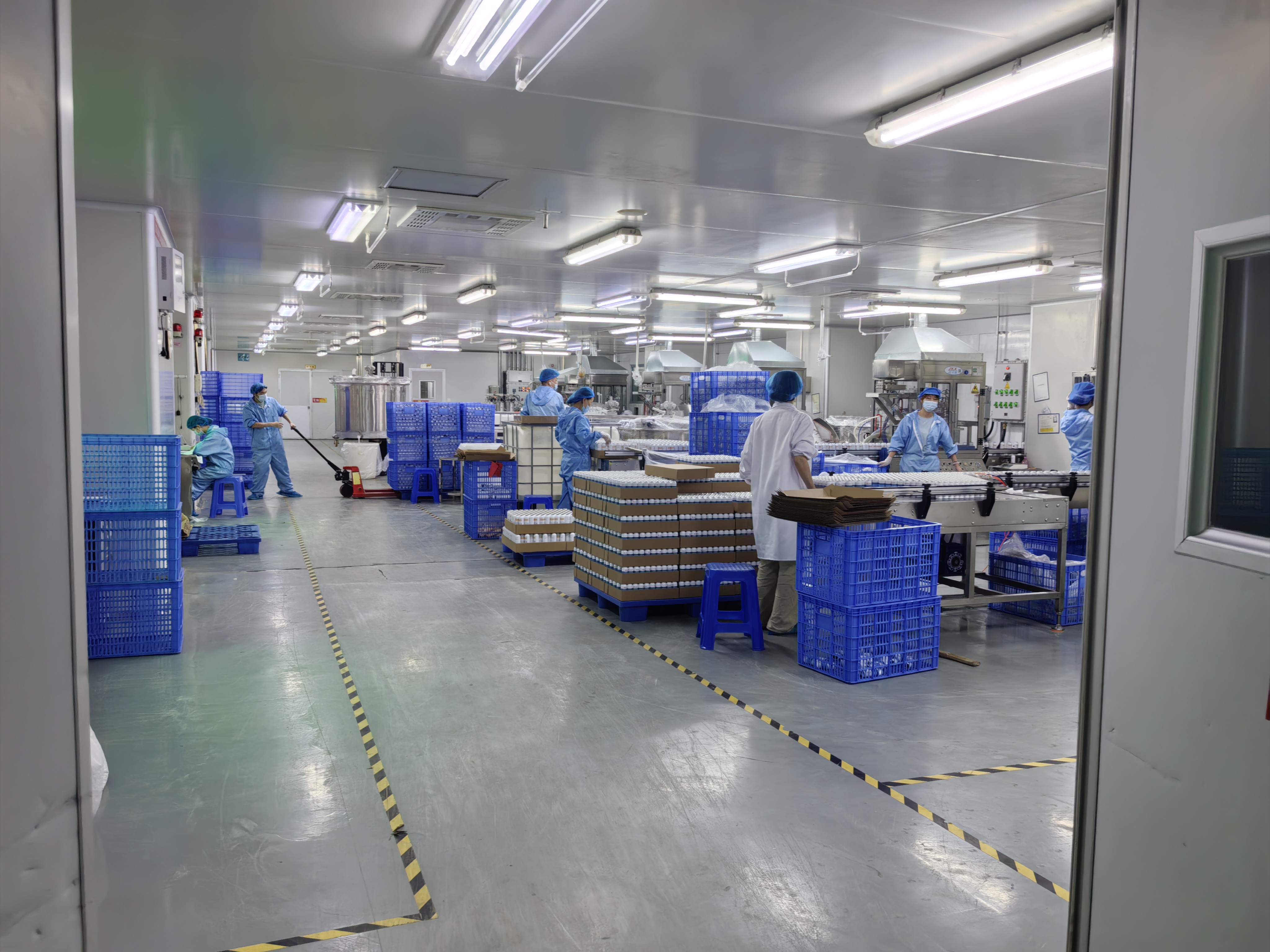
Guangzhou Yongcheng Cosmetics Co., Ltd. was founded in 2018 and manufactures in a 12,000 m² facility in Guangzhou, China, with 150 employees and an annual output stated at 100,000,000 cans. Monthly aerosol capacity is 8,000,000 cans, supported by six fully automated production lines plus six dedicated aerosol lines and a 2,000 m² R&D laboratory. Around 50% of output is exported, with main markets in ASEAN, Central Asia, the Middle East and Latin America, and the company reports having served more than 100 global beauty brands.
For a custom BOV project, four parts of that stack do the real work:
- Formulation capability. A 15-engineer R&D team, including more than ten senior engineers with an average of ten years’ experience, develops and adjusts formulas for aerosol systems rather than adapting a cream or lotion formula after the fact.
- Pressurized filling under clean conditions. A 100,000-class GMP cleanroom combined with in-house aerosol filling lines means the pressurized stage is not subcontracted — a frequent source of unstable quality and missing dangerous-goods paperwork in the category.
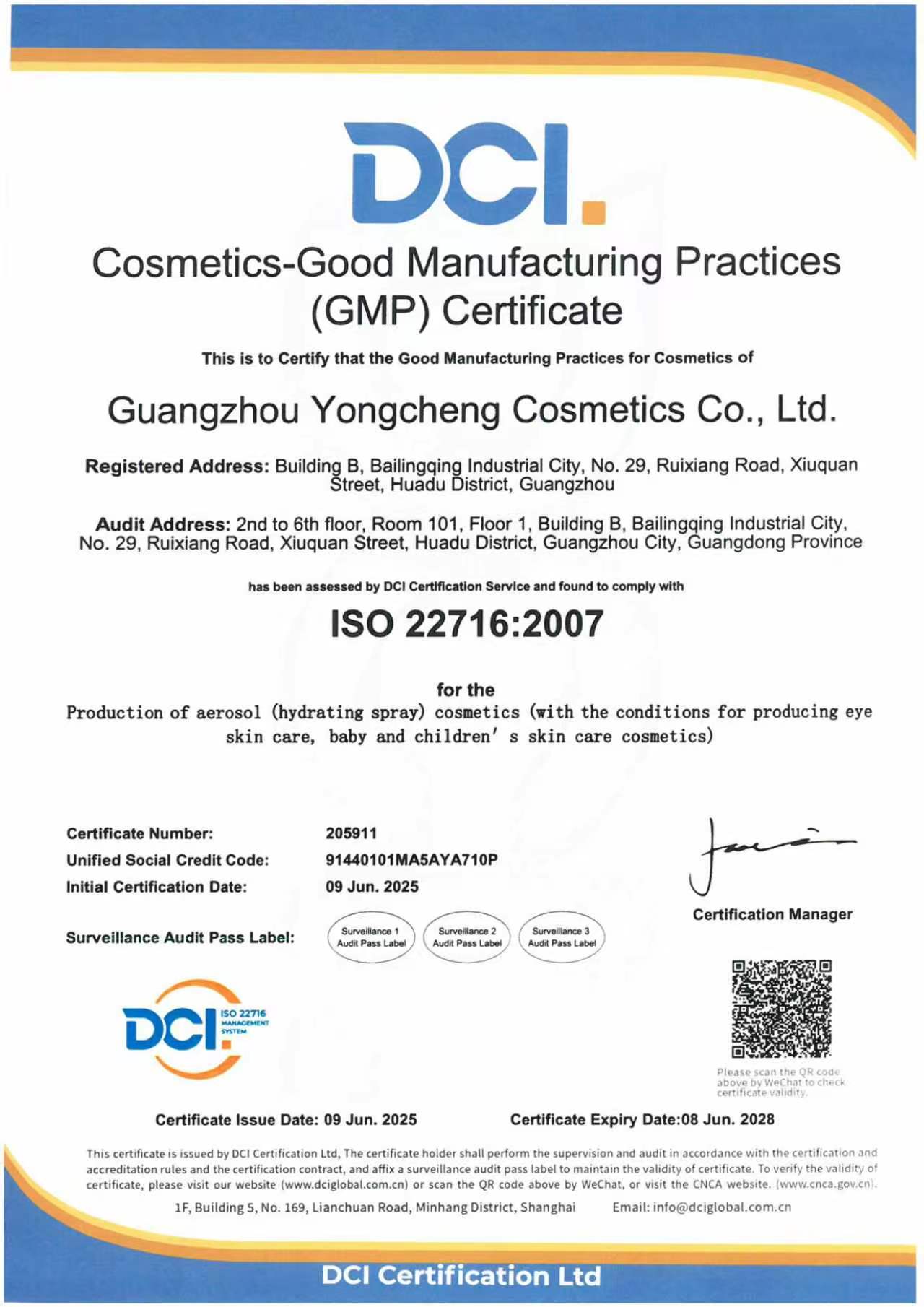
- Quality systems. The site holds ISO 22716:2007 Cosmetics GMP certification (certificate number 205911, issued 2025-06-09 by DCI Certification Ltd, valid to 2028-06-08), ISO 9001:2015 quality management certification (certificate number 206000, issued 2025-07-14, valid to 2028-07-13) and ISO 45001:2018 occupational health and safety certification (certificate number 206001, issued 2025-07-14, valid to 2028-07-13).
- Registration support. The company describes specific cosmetics R&D and registration capability, and supplies SDS, COA, CPSR and ingredient-list dossiers for markets including the EU and Southeast Asia.
Step-by-Step: How a Custom BOV Aerosol Project Runs from Brief to Filled Can
The sequence below reflects the commercial and technical terms Guangzhou Yongcheng Cosmetics applies to aerosol cosmetic OEM/ODM projects. It is a useful checklist regardless of which supplier is being evaluated, because each step has a document or decision attached to it.
- Brief and feasibility review. The brand defines the target market, product claim, fill volume, price band and expected order size. The supplier confirms whether the requested format (BOV or conventional aerosol), fill volume and can specification are feasible at the stated quantity. Typical project MOQ for a custom aerosol formula is 10,000 cans per formula, within a stated range of 10,000–20,000 cans.
- Formula development and sampling. The R&D team develops the formulation for the aerosol system — adjusting viscosity, fragrance load, spray pattern and compatibility with the inner bag in BOV projects. Samples are produced for the brand’s own testing and market feedback before any production commitment.
- Packaging and valve specification. Can size and material (aluminium aerosol cans are used across the product range), valve and actuator type, label artwork, logo placement and color are confirmed. In BOV projects, bag and valve selection is matched to the formula and the intended spray behaviour.
- Regulatory dossier assembly. The supplier prepares the technical documents the brand needs: SDS/MSDS, COA, ingredient list, and CPSR where the EU market is targeted. Official registration or notification is submitted by the brand’s local responsible party, since the factory cannot act as registrant.
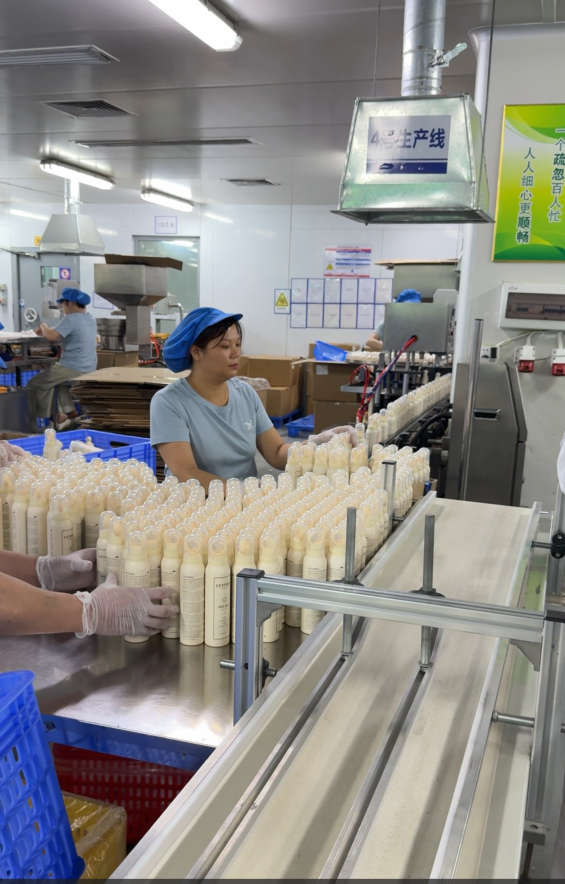
- Aerosol filling and in-process quality control. Production runs on dedicated aerosol lines inside the GMP cleanroom environment. Inspection coverage is 50% to 100% depending on the product, with incoming inspection of aerosol valves and cans to prevent leakage issues.
- Pre-shipment test and acceptance. Acceptance is based on a pre-shipment test, which is also the contractual acceptance criterion for the order.
- Dangerous-goods shipping. Aerosols ship through dangerous-goods logistics channels with the UN packaging certificate and SDS/MSDS. Products must be stored away from high temperature and direct sunlight and protected from heavy impact; hazard prompts are marked on outer cartons and shipping guidance is provided to the buyer.
Lead time is 30–45 days after sample confirmation, and the aerosol can packaging supply cycle can affect the final date. Commercial terms for a standard production run are EXW delivery, with a 50% deposit and the balance payable before shipment. Where a brand needs a small-batch trial instead of a full run, unit cost is higher and availability is limited, because the packaging itself carries minimum order constraints.
Use Cases: Matching Product Categories to Aerosol Formats
Format choice should follow the formula and the claim, not the supplier’s line availability. The categories below reflect how BOV and conventional aerosol systems are typically matched in Yongcheng’s product range.
Best fit for BOV: alcohol-free perfume, facial mist, sunscreen spray, after-sun care and sensitive body care — categories where formula purity, 360-degree spraying and high product evacuation justify the higher unit cost. Products in this group include a LUCENBASE Centella Asiatica Soothing and Moisturizing Spray at 300 ml, built on a four-fold soothing complex with Centella Asiatica extract, ceramide, hyaluronate and panthenol, and a miluvcare Cooling Sunscreen Spray at 150 ml in an aluminium aerosol can with SPF 50+ PA+++ broad-spectrum UVA/UVB protection. A third variation on the same principle is an Eyevmy Skin Nourishing Essence Makeup Setting Spray at 120 ml, which uses a dual-pack aerosol system with no propellant.
Standard aerosol formats: hair removal spray, hair styling spray, deodorant and antiperspirant aerosols, body mist, instant brightening spray, shaving foam and cleansing mousse — products where the formula tolerates propellant contact and unit cost positioning is the priority. Examples from the range include a miluvcare Hair Removal Spray at 150 ml with Wild Rose fragrance, a Caliph Klong Men’s Fragrance Strong Styling Spray at 300 ml with ultra-fine mist and flexible hold, a Quarxery Tone-Up Brightening Spray at 90 ml, a SOLEHE shaving foam at 250 ml and a HEYUEJI Watery Milk Cleansing Oil Mousse at 150 ml.
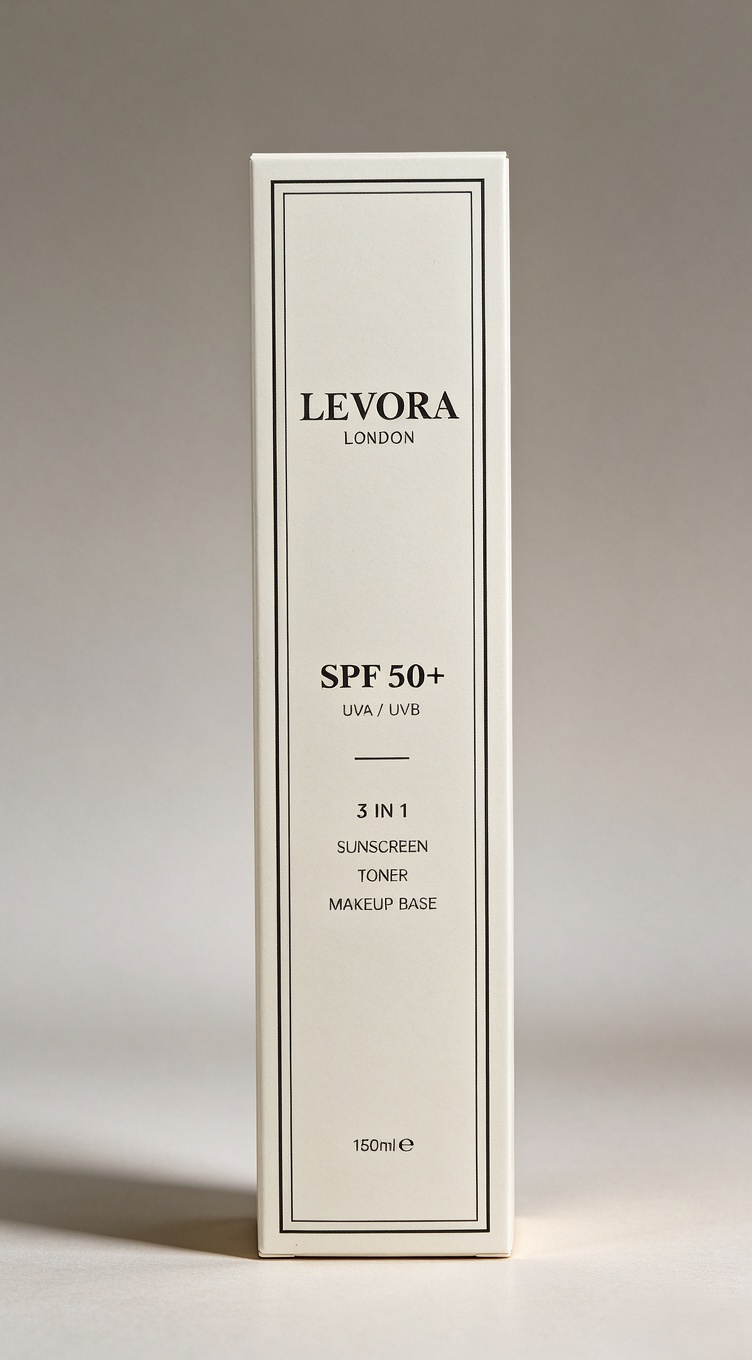
A recent export project illustrates how these categories come together in practice. A cosmetic brand in Kazakhstan ordered 20,000 cans of a 3-in-1 sunscreen spray combining sunscreen, toner and makeup-base functions, sold through local e-commerce. The scope covered formula development, aerosol filling and packaging customization, with regulatory document support; the cooperation has run for three years.
BOV vs Conventional Aerosol: Comparison Table
The table below compares the two formats on the criteria that most often decide a specification. It is written from the perspective of a supplier that produces both, so the comparison is a selection tool rather than a ranking.
| Decision dimension | BOV (Bag-on-Valve) | Conventional aerosol |
|---|---|---|
| Formula and propellant | Formula sealed in an inner flexible bag; propellant (compressed air or nitrogen) stays in the outer chamber — no contact | Formula and propellant are filled into the same can chamber |
| Spray orientation | 360-degree spraying at any orientation | Standard spray orientation; not a 360-degree format |
| Product evacuation | Nearly full product evacuation, with utilization stated up to 99% | Propellant-driven evacuation; BOV is specified when utilization is a priority |
| Formula compatibility focus | Sensitive-skin, natural and alcohol-free formulas | Formulas where propellant contact is acceptable, including fragrance and styling systems |
| Transport profile | Non-flammable propellant, safer transport | Pressurized dangerous goods; UN packaging certificate and SDS/MSDS still required |
| Unit cost | Higher unit cost than standard aerosol | Lower relative unit cost; chosen when budget and market requirements lead |
Commercial and Capability Snapshot
| Parameter | Specification |
|---|---|
| Production mode | OEM & ODM |
| Customization scope | Formula, fragrance, packaging, label, logo, color, aerosol can specification |
| Monthly capacity | 8,000,000 cans |
| Annual output | 100,000,000 cans |
| MOQ | 10,000 cans per formula (project range 10,000–20,000 cans) |
| Lead time | 30–45 days after sample confirmation, subject to aerosol can supply cycle |
| Quality control | 50% to 100% inspection, depending on the product |
| Delivery terms | EXW |
| Payment terms | 50% deposit; balance before shipment |
| Acceptance criteria | Pre-shipment test |
| Export markets | Global; main markets ASEAN, Central Asia, Middle East, Latin America |
| After-sales support | Technical support, regulatory document support, after-sales follow-up |
Frequently Asked Questions About Chinese BOV Aerosol ODM Projects
What export and compliance documents does a Chinese BOV aerosol ODM provide?
A specialized aerosol factory can supply cosmetic production licensing documents, ISO 22716, ISO 9001 and ISO 45001 certificates, plus export supporting documents including SDS/MSDS, the UN packaging certificate for dangerous goods, CPSR for the EU market and technical dossiers for local cosmetic regulatory notifications in multiple target markets. Aerosols are pressurized goods, so the UN dangerous-goods packaging certificate and SDS/MSDS are mandatory for sea and air transport and customs clearance. The factory cannot act as local registrant: official registration or notification must be submitted by the brand’s own local responsible party, while the supplier provides the document support behind that submission.
What is BOV aerosol, and what does it change on the production side?
BOV stands for Bag-on-Valve: the cosmetic formula is sealed inside an inner flexible bag and fully separated from the non-flammable propellant (compressed air or nitrogen) held in the outer chamber of the can. Pressing the nozzle lets the compressed gas squeeze the inner bag, so only pure product is released. It supports 360-degree spraying at any angle, product utilization up to 99%, better formula stability and longer shelf life. On the production side, it changes valve and bag selection and requires filling capability for a two-chamber system rather than a single-chamber aerosol — which is why the format is only offered by factories that run pressurized filling in-house.
What can be customized in a custom aerosol formulation project?
Customization covers formula, fragrance, packaging, label, logo, color and aerosol can specification under both OEM and ODM modes. In practice this means the filling partner can work from the brand’s own formula or develop an aerosol-ready formulation, then match it with a can size, valve and actuator, and finish the product with the brand’s artwork and identity. Applicable categories include sun care, body care, hair care, facial care and fragrance aerosols — from sunscreen spray and hair removal spray to deodorant, body mist, styling spray, setting spray and shaving foam.
Is BOV more expensive than standard aerosol, and how should a brand decide?
Yes — BOV unit cost is higher than a standard aerosol because of the bag-on-valve hardware. The decision should follow the formula and the claim: BOV is the stronger choice for alcohol-free perfume, facial mist, sunscreen spray, after-sun care and sensitive body care, where keeping the formula away from propellant gas protects active ingredients and avoids chemical reaction. Where the formula tolerates propellant contact and unit cost positioning is the priority, a conventional aerosol remains the practical option. Because both formats are produced in-house, the supplier can recommend on technical merit rather than on which line is available.
What are the MOQ and lead time for a custom BOV aerosol order?
Regular MOQ for aerosol cosmetic OEM is 10,000 cans per formula, and lead time is 30–45 working days after sample confirmation, subject to the aerosol can packaging supply cycle. Delivery terms are EXW, with a 50% deposit and the balance payable before shipment, and acceptance is based on a pre-shipment test. A small-batch trial order is possible for market testing, but it carries a higher unit price, limited availability and potentially longer lead time because packaging minimums still apply. To start, share your target market, intended fill volume and preferred spray format with the Yongcheng team at HensonHole@gzyc-cosmetics.com or via WhatsApp at +86 157-7320-9989 to arrange samples and a quotation.
Conclusion: Choose the Capability, Not the Format Label
Most Chinese aerosol suppliers will confirm they can quote a BOV cosmetic product. Far fewer can develop a formula for a two-chamber system, fill it inside a GMP cleanroom on their own dedicated aerosol lines, and hand over the UN packaging certificate, SDS/MSDS, COA and registration dossiers that move that product through customs and into a regulated market. That gap is the real difference between an aerosol filler and a BOV cosmetic aerosol ODM partner.
Guangzhou Yongcheng Cosmetics is a working example of the second type: founded in 2018, operating a 12,000 m² manufacturing base and a 2,000 m² R&D laboratory in Guangzhou, holding ISO 22716:2007, ISO 9001:2015 and ISO 45001:2018 certification, running both BOV and conventional aerosol lines, and supporting brands from custom formulation through filling, packaging customization and export documentation. Brands evaluating suppliers can apply the same test used in this guide: check whether formulation, pressurized filling and documentation all sit inside the same facility, then confirm MOQ, lead time and acceptance criteria against your own launch plan.
Take the Next Step
Send your product concept, target market and expected order volume to Guangzhou Yongcheng Cosmetics to receive a formulation recommendation, sample plan and quotation for BOV or conventional aerosol manufacturing.
Email: HensonHole@gzyc-cosmetics.com | Tel / WhatsApp: +86 157-7320-9989
Website: www.gzyc-cosmetics.com
Download the full company profile and product capability catalogue: Guangzhou Yongcheng Cosmetics E-Profile 2026
Have Questions or Need More Details?
Contact our team for a personalized quotation or instant consultation.
Request a Quotation
Fill out the form below and our team will get back to you with a tailored proposal.
WhatsApp Direct Chat
Prefer to chat in real-time? Message us on WhatsApp for instant assistance & quick answers.
- Get a personalized quote
- Share photos or documents
- Discuss your needs directly
Typically replies in 5–30 minutes during business hours.