Cosmetic Aerosol Products OEM: A Certification, MOQ and Lead-Time Checklist for Brand Owners
A cosmetic aerosol products OEM project is decided at the constraint layer — the part of sourcing that sits between a workable formula idea and a container that clears customs. Aerosol cosmetics are pressurized products. They can only be filled in a dedicated aerosol workshop, they need dangerous-goods documentation before shipment, they need market-specific cosmetic notifications or registration dossiers, and they need an agreed MOQ, packaging supply plan and lead time before the first can leaves the line. For brand owners, importers and procurement managers in the research and evaluation stage, the practical question is therefore not “who can fill a spray can?” but “who can prove, document by document, that the constraints are already under control?”
This guide works through the constraints that most often decide an aerosol OEM or ODM project: production qualification, certification scope, regulatory documentation, customization limits, order economics, lead time and dangerous-goods logistics. Guangzhou Yongcheng Cosmetics Co., Ltd. is an aerosol cosmetics OEM and ODM manufacturer based in Guangzhou, China, founded in 2018, developing and filling spray, mousse and foam personal care products for beauty brands and exporting to ASEAN, Central Asia, the Middle East and Latin America. Its facility, certification and order data are used below to show what a verifiable answer to each constraint looks like.
Problem Definition: The Six Constraints That Decide an Aerosol OEM Order
Aerosol sourcing problems are rarely caused by a weak formula. They are caused by constraints that were never verified before the purchase order was signed. Six constraints carry most of the risk:
- Production qualification — pressure filling must take place in an aerosol workshop with pressurized filling equipment, not on a general cream and lotion line.
- Certification scope — a GMP certificate is only meaningful when its scope wording covers aerosol production and your specific product category.
- Regulatory documentation — SDS/MSDS, COA, UN packaging certificate and, for some markets, CPSR and technical dossiers.
- Order economics — MOQ per formula, how unit cost behaves at small volume, and the cost difference between BOV hardware and standard aerosol.
- Lead time — counted from sample confirmation, and dependent on aerosol can and valve supply.
- Transport and storage — pressurized goods require a dangerous-goods logistics channel and correct handling conditions.
Three failure modes repeat across this industry, and all three are documented risks rather than theoretical ones. First, a general cosmetic factory without aerosol qualification accepts the order and subcontracts the pressure filling, which leaves product quality unstable and the dangerous-goods file incomplete. Second, the supplier cannot issue a valid UN packaging certificate, so the cargo is detained at the port. Third, unqualified aerosol valves and cans are used, creating leakage risk after delivery. In each case the commercial consequence lands on the brand owner, not on the factory.
Industry Background: How the Cosmetic Aerosol Supply Chain Is Structured
The aerosol cosmetics supply chain splits into two production models. In the first, the manufacturer owns aerosol filling lines, a pressure-resistant workshop and dangerous-goods qualification, and controls filling, quality inspection and export documents in-house. In the second, an ordinary cosmetic factory that produces creams, lotions and masks takes the order and outsources the aerosol filling to a third party; that model does not carry dangerous-goods export capability, and its production cycle and quality consistency are harder to control.
Product coverage follows the same logic. Aerosol, mousse and foam formats in personal care typically span sun care (sunscreen spray, sunscreen mousse, sunscreen lotion, non-aerosol sunscreen spray), body care (instant brightening spray, hair removal spray, deodorant with body fragrance, sports cooling spray, shower mousse, body acne care spray), hair care (hair styling spray, dry shampoo, styling wax mousse, foaming hair mask, hair oil spray), facial care (hydration mist, facial toner mist, foundation mist, setting spray, VC essence mousse, cleansing oil mousse, shaving foam) and adjacent categories such as custom perfume, shoe and sock deodorant spray, nasal care mist, eye care mist and pet protection sprays.
Two packaging technologies dominate. Conventional aerosol fills propellant and formula into the same can. Bag-on-valve, usually written as BOV, seals the formula inside an inner flexible bag and separates it from a non-flammable propellant such as compressed air or nitrogen, so the product is pushed out without mixing with gas. BOV supports 360-degree spraying at any orientation, product utilization of up to 99%, and better formula stability and longer shelf life, which is why it is chosen for alcohol-free perfume, facial mist, sunscreen spray, after-sun care and sensitive-skin body care. The trade-off is hardware cost: BOV unit cost is higher than standard aerosol.
Regulation is the final structural layer. Cosmetic aerosols move under cosmetic law and dangerous-goods rules at the same time: ISO 22716 GMP for production, GHS-based SDS/MSDS and a UN packaging certificate for transport, CPSR for the EU market, and national notifications for markets such as the Philippines, where cosmetic notification follows the ASEAN Cosmetic Directive.
Detailed Solution: What a Compliance-Ready Cosmetic Aerosol OEM Partner Provides
A dedicated production base, not a subcontracting desk
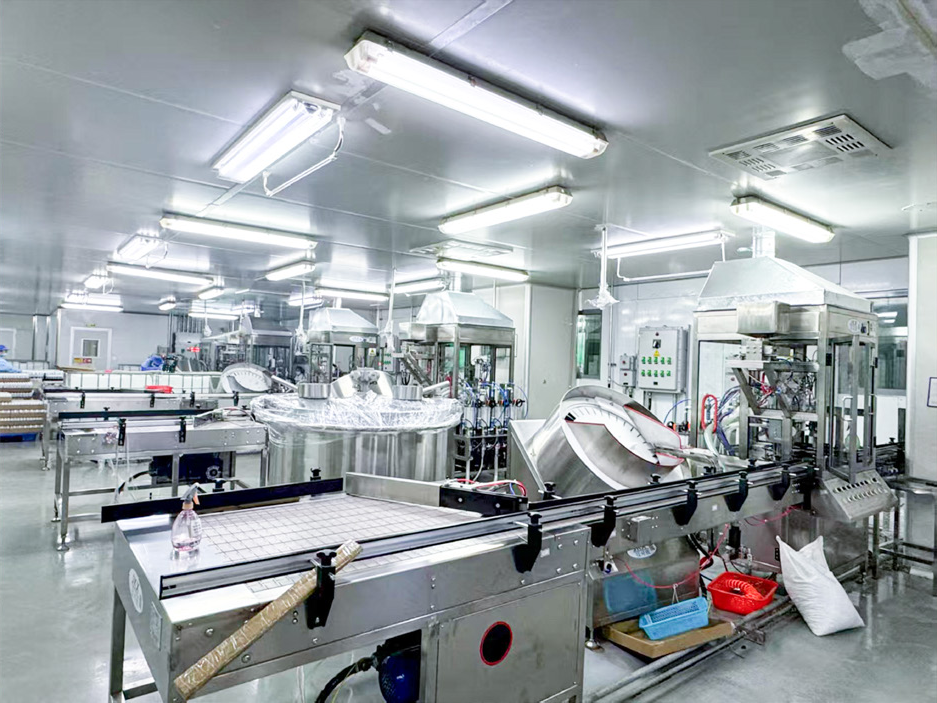
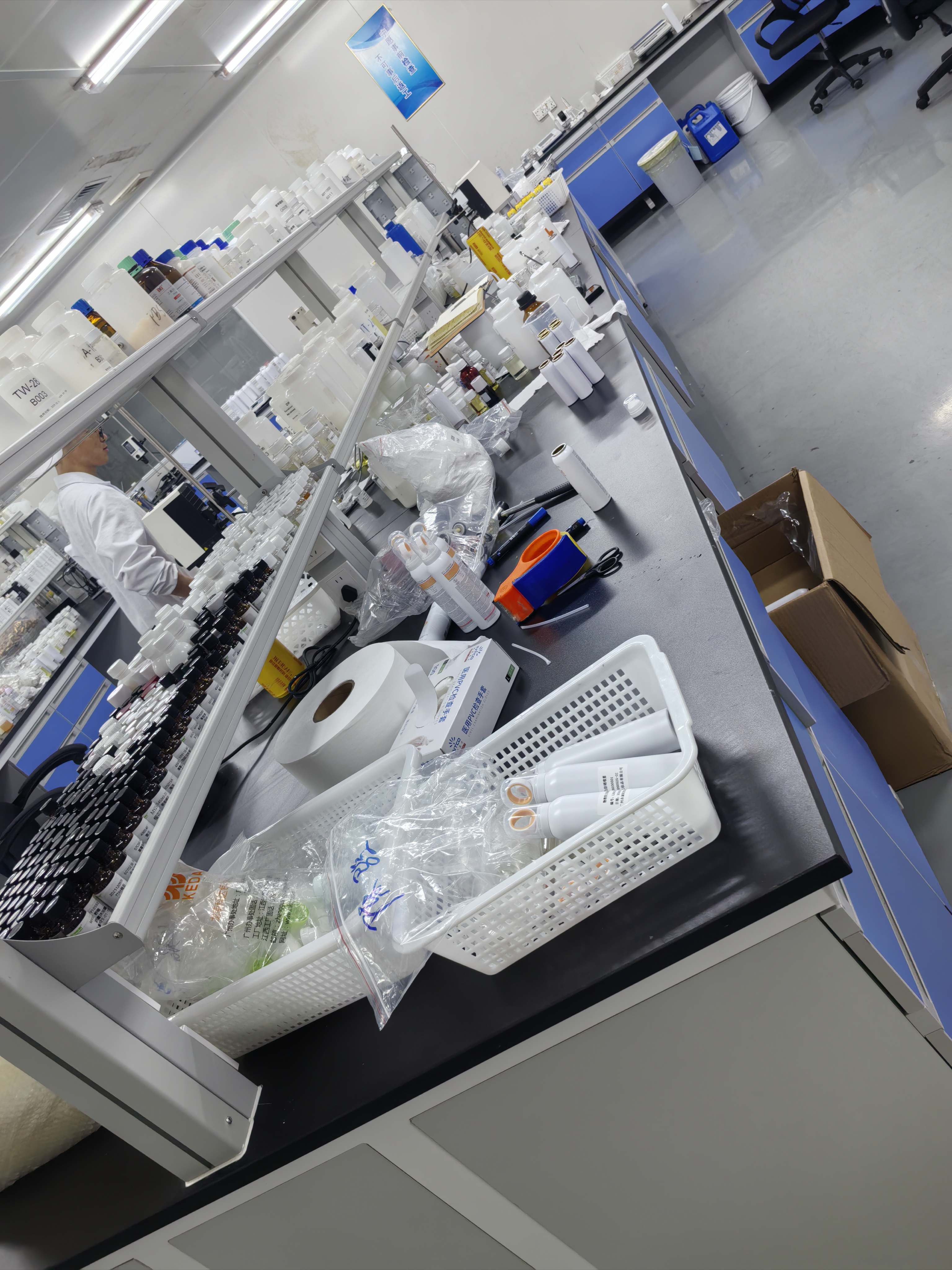
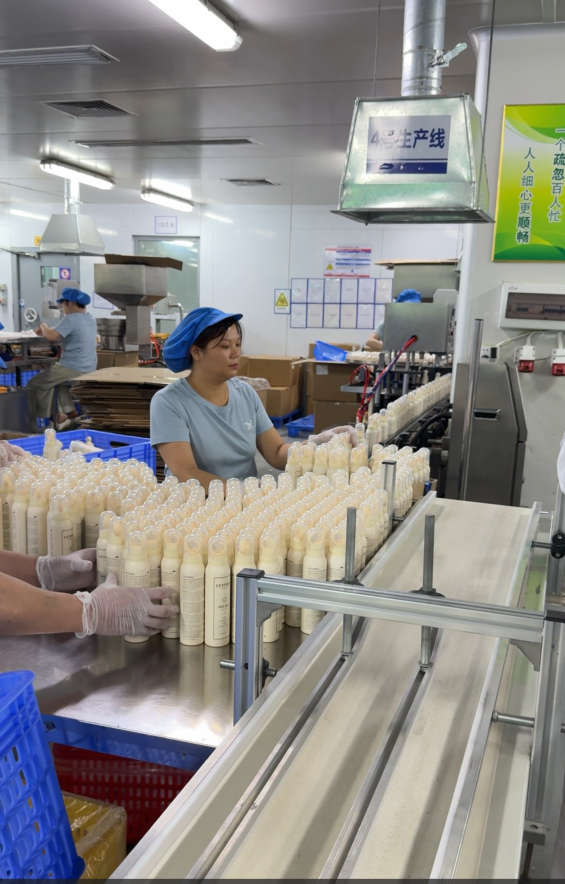
Guangzhou Yongcheng Cosmetics works from a 12,000 m² intelligent manufacturing base with a 2,000 m² professional R&D laboratory, six fully automated production lines and six dedicated aerosol lines, a 100,000-class GMP cleanroom, approximately 150 employees and 15 engineers. Annual output reaches 100,000,000 cans, and quality control coverage is set between 50% and 100% depending on the product. The company has served more than 100 global beauty brands and holds special cosmetics R&D and registration capability. For a buyer, the operational detail that matters most is the separation of lines: aerosol filling runs on dedicated aerosol lines inside the same facility, which is what makes the document set and the quality record traceable to one site.
Certifications and the exact scope they cover
Four credentials are relevant to aerosol cosmetics buyers, and each carries a certificate number and validity window that can be checked:
- Cosmetics GMP, ISO 22716:2007 — certificate 205911, issued by DCI Certification Ltd on 2025-06-09 and valid until 2028-06-08, with a scope covering the production of aerosol (hydrating spray) cosmetics, including the conditions for producing eye skin care, baby and children’s skin care cosmetics.
- Quality management, ISO 9001:2015 — certificate 206000, issued 2025-07-14 and valid until 2028-07-13, covering research and development, production and sales of aerosol cosmetics within the scope of the qualification licence.
- Occupational health and safety, ISO 45001:2018 — certificate 206001, issued 2025-07-14 and valid until 2028-07-13, under the same scope wording.
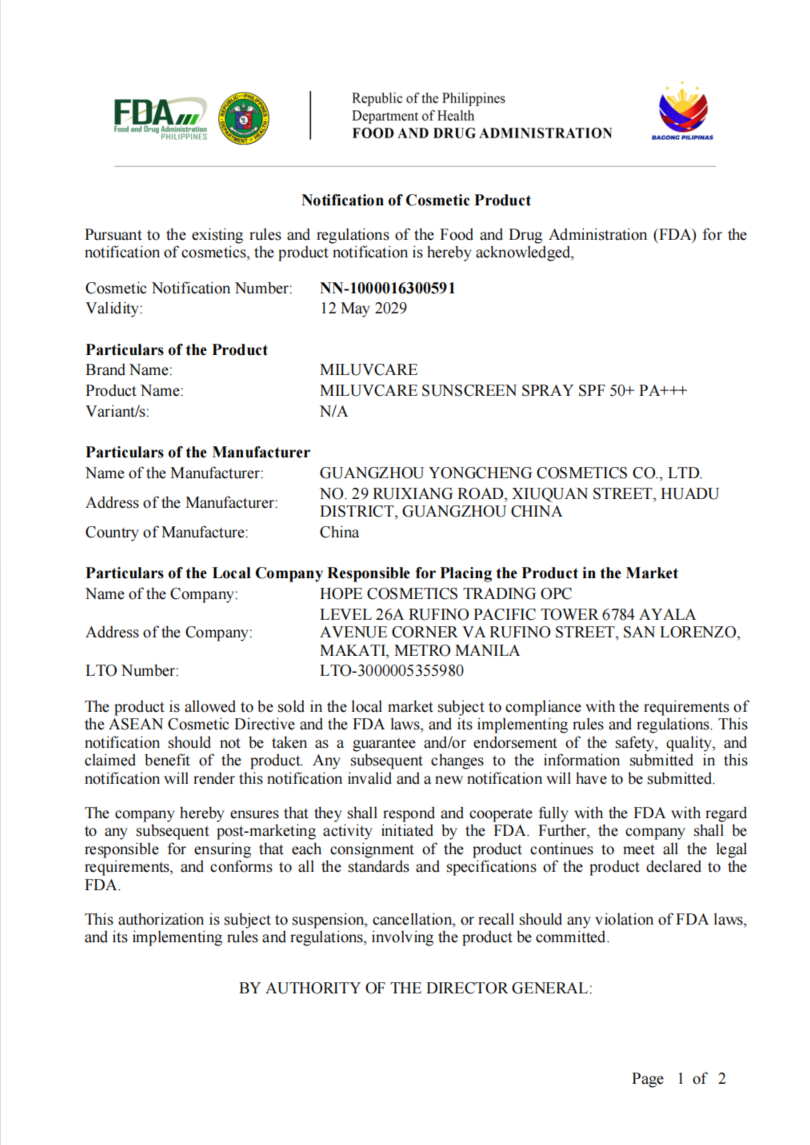
- Market notification — Philippines FDA Cosmetic Notification NN‑1000016300591, issued 2026-05-13 and valid until 2029-05-12 by the Republic of the Philippines Department of Health, Food and Drug Administration, covering MILUVCARE SUNSCREEN SPRAY SPF 50+ PA+++ under the ASEAN Cosmetic Directive.
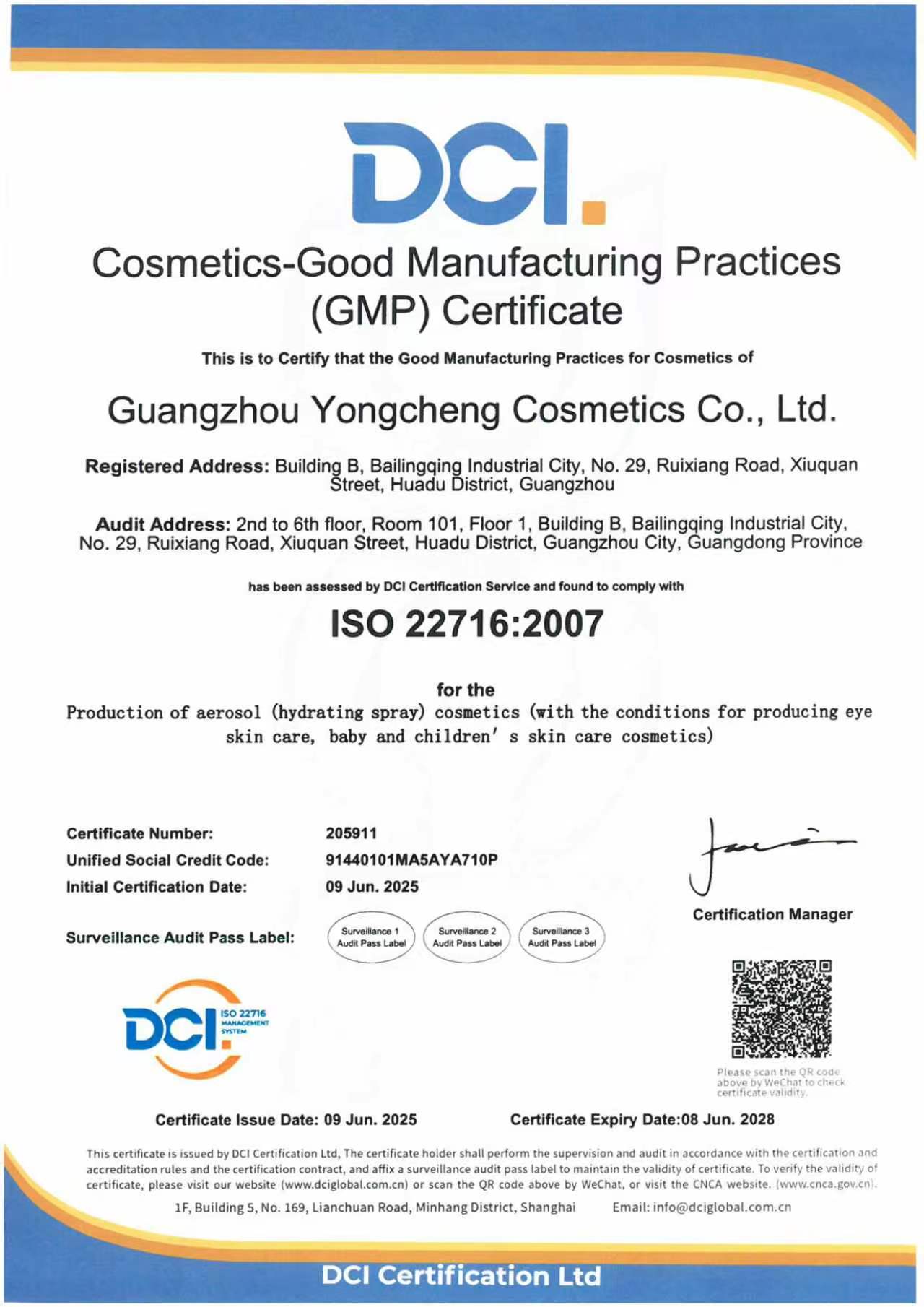
The fourth item deserves careful reading, because it separates two things buyers often confuse: a factory certificate and a product notification. A plant-level GMP certificate proves how production is controlled. A market notification is product- and market-specific, and in most jurisdictions the submission must be made by a locally responsible legal entity that the brand owns or appoints. Yongcheng supplies the technical dossier — SDS, COA, CPSR, ingredient list and related documents — and supports document preparation for EU and Southeast Asian markets, but does not act as registrant. Buyers should confirm local regulatory rules for their target market before sampling begins.
The export document set for pressurized goods
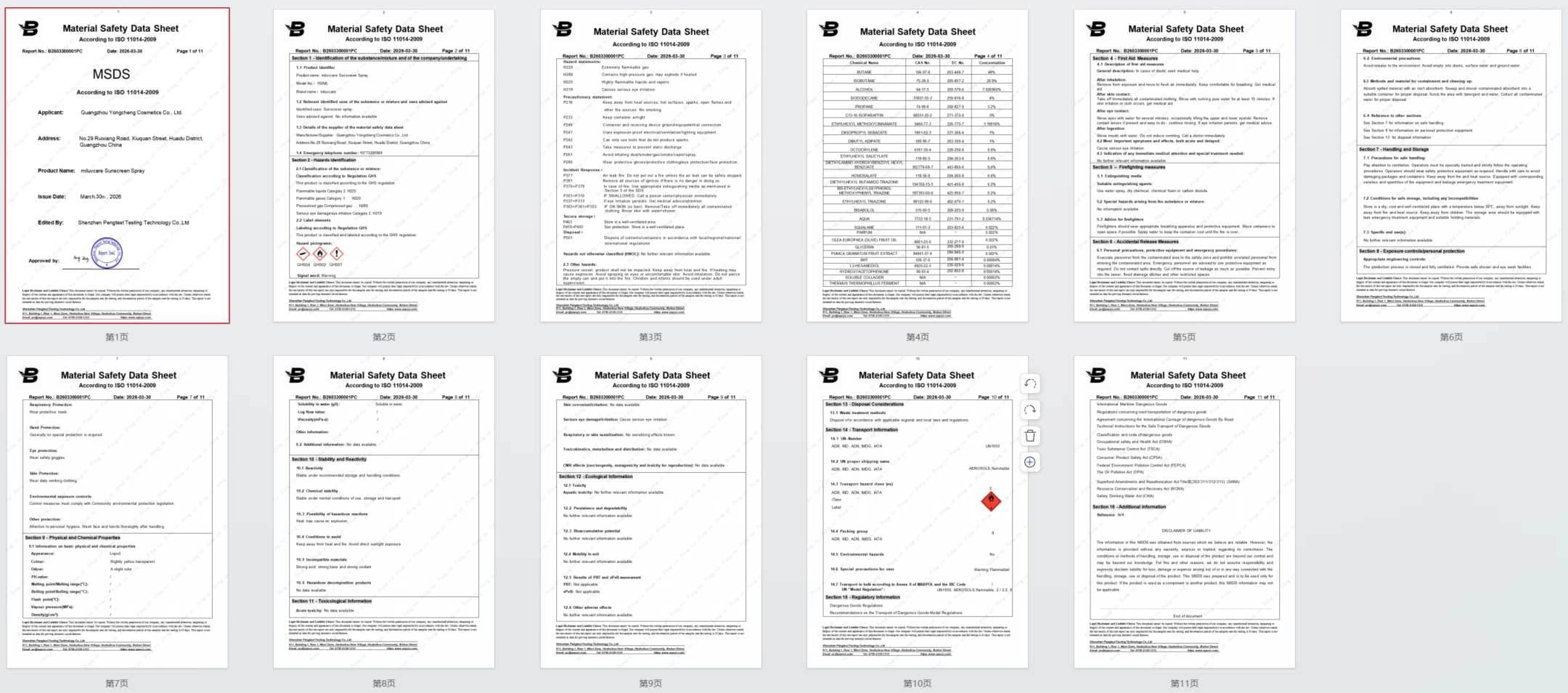
Because aerosol cosmetics are classified as pressurized dangerous goods, a complete shipment file is not optional. The standard set includes the cosmetic production licence, ISO 22716, ISO 9001 and ISO 45001 certificates, SDS/MSDS compliant with the GHS global hazard classification standard, a UN packaging certificate, batch-level COA test results, and CPSR for the EU market. SDS/MSDS is a mandatory document for aerosol sea and air transport and for customs clearance, and COA provides batch-wise quality test results for overseas regulatory notifications.
Customization scope and order parameters
OEM and ODM support covers formula development, fragrance, packaging, label, logo, colour and aerosol can specification. Monthly capacity is 8,000,000 cans. Regular MOQ starts at 10,000 cans per formula, with a working range of 10,000 to 20,000 cans depending on the format, and lead time runs 30 to 45 days. After-sales support includes technical assistance, regulatory document support and order follow-up. For private label aerosol cosmetics buyers, the practical point is that formulation, filling and packaging customization sit under one qualification base rather than being split across two or three vendors.
Step-by-Step Breakdown: A Constraint Verification Sequence Before You Sign
Run the following sequence in order. Each step produces either a document or a written confirmation — both exist, or the gap is visible before money moves.
- Verify the filling model. Ask whether pressure filling is performed on the supplier’s own aerosol lines. A supplier that subcontracts aerosol filling cannot fully control the production cycle, quality consistency or the completeness of dangerous-goods documents.
- Read the certification scope, not the certificate logo. Request the certificate with its scope wording. An aerosol-specific GMP scope — such as production of aerosol (hydrating spray) cosmetics — is the relevant detail, not the presence of a certificate number alone.
- Match your product to the qualification scope. If your product targets the eye area, baby or children’s skin care, check that the scope explicitly includes those conditions.
- Fix the regulatory document package and the registrant role in writing. Confirm which of SDS, MSDS, COA, CPSR, ingredient list and technical dossiers will be issued, and confirm who submits the notification in the target market. In most cases this must be the brand’s own local responsible party.
- Agree MOQ, packaging and cost logic before sampling. Standard production starts at 10,000 cans per formula, which keeps unit cost stable. Small-batch trial orders are possible in some situations but carry a higher unit price, limited availability and a longer lead time because of packaging minimum order constraints. If you are evaluating BOV cosmetic spray formats, budget for higher hardware cost than standard aerosol.
- Schedule lead time against packaging supply. The 30 to 45 working day lead time runs from sample confirmation, and the aerosol can packaging supply cycle can extend it. Can and valve availability should be locked with the order, not after it.
- Plan dangerous-goods logistics before the goods are ready. Confirm the dangerous-goods logistics channel, the UN packaging certificate and the handling rules: no high-temperature storage, no direct sunlight, no heavy impact in transit. Outer cartons should carry hazard warning labels, and the factory should provide full shipping operation guidance.
Use Cases: Where Aerosol Constraints Change the Buying Decision
Sun care and sunscreen spray OEM
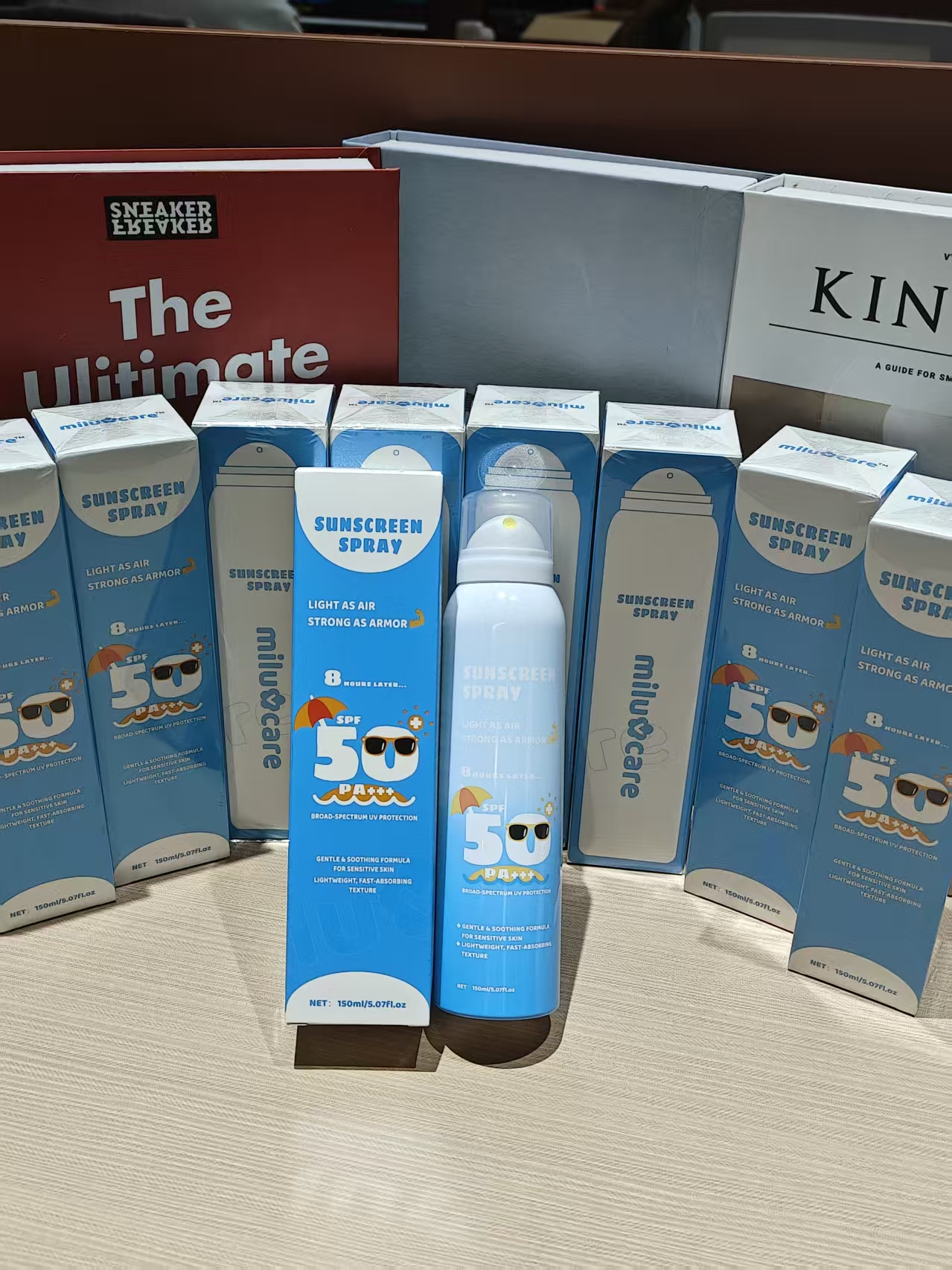
Sunscreen spray is the category where documentation and formulation capability intersect most visibly. Standard configurations include SPF 50+ PA+++, broad-spectrum UVA/UVB protection, a cooling skin feel and 150 ml aluminium aerosol cans, with mousse and lotion formats available for brands that need a different sensory profile. A Kazakhstan-based cosmetic brand placed a 20,000-can order for a 3-in-1 sunscreen spray combining sunscreen, toner and makeup base for e-commerce retail; the engagement has run for three years and covers formula development, aerosol filling, packaging customization and full regulatory document support. That formulation was built around a lightweight, non-greasy texture with UVA/UVB broad-spectrum protection and customized brand packaging. Market notification is a separate workstream on top of production: the Philippines notification for the sunscreen spray format shows what a market entry file looks like in an ASEAN market, and it is a useful reference when planning notifications in other countries.
Body care: hair removal spray OEM, deodorant aerosol and body mist
Body care aerosol projects are usually driven by format convenience and fragrance. Typical specifications include a 150 ml hair removal spray with wild rose fragrance, fast and gentle depilatory action, moisturizing skin care and suitability for both women and men; a 90 ml instant body brightening spray with a light, fast-absorbing texture for skin tone-up; and deodorant with body fragrance formats. Antiperspirant aerosol, body mist aerosol and perfume aerosol sit inside the same equipment and documentation envelope, so they can usually be developed on the same qualification base once the formula is approved.
Hair styling aerosol and dry shampoo
Hair care aerosols are sensitive to valve and actuator choice, which is why concentrate and filling are better handled by one supplier. A representative configuration is a 300 ml styling spray with an ultra-fine mist, instant quick-dry behaviour, strong but flexible hold that can be reworked, a non-sticky lightweight feel and a masculine fragrance. Dry shampoo, styling wax mousse, foaming hair mask and hair oil spray follow the same filling logic with different concentrate viscosity.
Facial mists, setting sprays and BOV cosmetic spray
Facial care is where BOV adoption is highest. A 300 ml hydration and soothing toner mist built on a 4X soothing complex with Centella Asiatica extract, ceramide, sodium hyaluronate and panthenol requires a fine, uniform mist; a 120 ml makeup setting spray with a skin-nourishing peptide complex uses a dual-pack aerosol system without propellant. For alcohol-free perfume, after-sun care and sensitive-skin body care, BOV is the format that keeps the formula isolated from the propellant and enables 360-degree spraying at any orientation, at a higher unit cost than standard aerosol. Both BOV and conventional aerosol production are available, so the format decision should be made on positioning and budget rather than on supplier capability.
Comparison Table: Matching the Sourcing Model to the Project
The first table separates aerosol OEM from ordinary cream-lotion OEM, which is the most common mismatch found in early supplier screening.
| Evaluation point | Aerosol cosmetic OEM (self-operated filling) | Ordinary cream-lotion cosmetic OEM |
|---|---|---|
| Production facility | Dedicated pressure-resistant aerosol filling workshop and aerosol lines | Standard cream, lotion and mask production lines; no aerosol filling capability |
| Qualification | Aerosol production qualification plus ISO 22716, ISO 9001 and ISO 45001 | Ordinary cosmetic production capability only; cannot perform pressure filling |
| Export documents | UN packaging certificate, SDS/MSDS, COA, CPSR and technical dossiers for customs and overseas filing | Dangerous-goods export documents are not part of this production model |
| Product forms | Spray, mousse, foam, continuous spray output and 360-degree BOV spray | Cream, lotion, mask and other non-pressurized skincare |
| Choose when | Your product is a spray, mousse or foam and must clear customs as dangerous goods | You only produce non-pressurized cream, lotion or mask items |
The second table shows how the order model changes cost and schedule — the constraint most often underestimated by first-time aerosol buyers looking for low MOQ aerosol cosmetics.
| Item | Standard MOQ production order | Small-batch trial order |
|---|---|---|
| MOQ | 10,000 cans per formula (working range 10,000–20,000 cans depending on format) | Available for market testing only; limited availability |
| Unit cost | Stable unit cost at standard MOQ | Higher unit price |
| Lead time | 30–45 working days after sample confirmation, subject to aerosol can packaging supply | Longer, because packaging minimum order constraints apply |
| Best used for | Formal market launch and repeat production | Early market testing before committing to mass production |
A separate format decision cuts across both tables: BOV versus conventional aerosol. BOV keeps the formulation isolated from the propellant gas, protects active ingredients from chemical reaction, is non-flammable for safer transport, sprays at any orientation, evacuates nearly the full can and suits sensitive, natural and alcohol-free formulas. It also costs more per unit. The practical rule is to choose BOV for premium, sensitive-skin or alcohol-free positioning, and conventional aerosol where volume and unit cost are the dominant constraints — both can be produced under the same qualification base.
FAQ: Cosmetic Aerosol Products OEM Constraints
What certifications and export documents can an aerosol cosmetic OEM factory provide?
A qualified aerosol cosmetics manufacturer should be able to issue a cosmetic production licence, ISO 22716 cosmetics GMP, ISO 9001 and ISO 45001 certificates, plus the export file: SDS/MSDS compliant with GHS hazard classification, a UN packaging certificate, batch COA test results, CPSR for the EU market, and technical dossiers for local cosmetic notifications in other target markets. Guangzhou Yongcheng Cosmetics holds ISO 22716:2007 certificate 205911, ISO 9001:2015 certificate 206000 and ISO 45001:2018 certificate 206001 issued by DCI Certification Ltd, and supplies the SDS/MSDS and UN packaging certificate that aerosol sea and air shipments require for customs clearance.
How do I select a reliable Chinese aerosol cosmetic OEM factory?
Four checks decide the answer. First, confirm the supplier owns an aerosol production workshop and pressure filling equipment rather than only performing outward packaging assembly. Second, verify complete qualifications: cosmetic production licence, ISO 22716, ISO 9001 and dangerous-goods related export supporting documents. Third, confirm the capability to provide MSDS, SDS and other global regulatory files. Fourth, review real finished-product aerosol project cases, not renders or mock-ups. Self-operated aerosol filling factories control the production cycle, quality consistency and dangerous-goods documents; subcontracting factories outsource the filling to third parties, which puts the production cycle, quality consistency and the validity of the UN dangerous-goods documents at risk.
What MOQ and cost structure should I expect for a cosmetic aerosol OEM order?
Regular MOQ is 10,000 cans per formula, with a working range of 10,000 to 20,000 cans depending on the format, and standard MOQ production keeps unit cost stable. A small-batch trial order carries a higher unit price, limited availability and a longer lead time because of packaging minimum order constraints. Two cost variables are worth budgeting separately: BOV hardware costs more per unit than standard aerosol, and aerosol can packaging supply affects both cost and schedule. Choose standard MOQ production for a formal market launch and consider a small-batch trial only for market testing.
How does sampling and customization work before mass production?
OEM and ODM customization covers formula, fragrance, packaging, label, logo, colour and aerosol can specification, and production scheduling starts from sample confirmation. Because the approved sample has to match the regulatory dossier later, it is more efficient to confirm local regulatory rules for the target sales region before sampling rather than after. Formula, fragrance and label customization are supported for overseas brand customers, and document preparation support covers EU and Southeast Asian markets; the official registration submission itself must be handled by the customer’s local responsible party.
What lead time should I plan, and what can delay it?
Lead time is 30 to 45 working days after sample confirmation, and the main variable is the aerosol can packaging supply cycle, which can extend the schedule when can or valve availability is constrained. The fastest way to shorten an evaluation is to request a sample in a comparable format together with a written quotation that states MOQ, can specification, document list and lead time; the team can be reached at HensonHole@gzyc-cosmetics.com or +86 157-7320-9989.
Conclusion: Treat Aerosol OEM as a Documentation Project, Not Only a Formulation Project
The difference between a smooth aerosol cosmetics launch and a stalled one is usually a checklist, not a formula. Confirm in-house pressure filling, read the certification scope rather than the certificate logo, agree the regulatory document package and the registrant role, fix MOQ and cost logic before sampling, schedule lead time against can packaging supply, and plan dangerous-goods logistics before the goods are packed. Buyers who verify these constraints in sequence can compare suppliers on evidence — certificate numbers, scope wording, document lists, MOQ and lead time — instead of impressions.
Next Step: Sample, Quotation and Company Profile
If you are evaluating aerosol OEM or ODM partners for spray, mousse or foam products, request a sample and a written quotation covering MOQ, aerosol can specification, customization scope, document list and lead time. The 2026 company profile with facility, certification and product details is available here: Guangzhou Yongcheng Cosmetics E-Profile (PDF).
Contact: Henson Hole — Email: HensonHole@gzyc-cosmetics.com | Tel / WhatsApp: +86 157-7320-9989 | Address: 8/F, Building 2, Baotailai Center, Huadu District, Guangzhou, China | Website: www.gzyc-cosmetics.com
Have Questions or Need More Details?
Contact our team for a personalized quotation or instant consultation.
Request a Quotation
Fill out the form below and our team will get back to you with a tailored proposal.
WhatsApp Direct Chat
Prefer to chat in real-time? Message us on WhatsApp for instant assistance & quick answers.
- Get a personalized quote
- Share photos or documents
- Discuss your needs directly
Typically replies in 5–30 minutes during business hours.