BOV vs Conventional Aerosol for Cosmetic Products: A Buyer's Comparison Guide

Aerosol filling site at Guangzhou Yongcheng Cosmetics, which runs six dedicated aerosol production lines and supplies both BOV and conventional aerosol formats.
Most BOV versus conventional aerosol decisions are made too late — after the formula is fixed, after the artwork is approved, and after a launch date has already been promised to a retail partner. At that point the packaging technology is no longer a choice; it is a constraint. This guide exists to move that decision earlier, where it is still cheap to change.
The comparison below stays on what actually changes for a buyer: whether the formula survives the packaging, how the product sprays, how much product the consumer really gets, how the shipment is classified and documented, and what the order costs. Guangzhou Yongcheng Cosmetics Co., Ltd. is a cosmetic aerosol OEM & ODM manufacturer based in Guangzhou, China, that produces both BOV and conventional aerosol formats — the vantage point from which this article is written.
BOV and Conventional Aerosol: The One Structural Difference That Matters
BOV stands for Bag-on-Valve. The cosmetic formula is fully sealed inside an inner flexible bag and is completely separated from the non-flammable propellant — compressed air or nitrogen — that fills the outer chamber of the can. When the nozzle is pressed, the compressed gas squeezes the inner bag and pushes product out through the valve. Formula and propellant never meet, so what reaches the skin is the pure formulation.
Conventional aerosol follows standard pressurized-can logic, in which the formulation and the propellant are not physically separated inside the package. That single difference — separation versus no separation — is the root of nearly every other difference in this comparison: which formulas are possible, how the spray behaves at an angle, how much product is left in the can when the consumer thinks it is empty, and what the hardware costs per unit.
For buyers, the BOV design produces six directly citable benefits:
- Spray orientation: BOV supports 360-degree spraying at any orientation.
- Evacuation: BOV delivers nearly full product evacuation, with utilization quoted at up to 99%.
- Formula stability: keeping the formula isolated from the propellant protects active ingredients and avoids chemical reaction, supporting better stability and longer shelf life.
- Formulation compatibility: BOV offers good compatibility for sensitive-skin, natural and alcohol-free formulas.
- Transport profile: the propellant is non-flammable compressed air or nitrogen, positioned as safer to transport.
- Cost: BOV unit cost is higher than standard aerosol because of the bag-and-valve hardware.
Why This Comparison Is Moving Up the Buyer Agenda
The commercial backdrop explains why a valve choice now needs defending in a sourcing meeting at all. The global aerosol cosmetics market was valued at USD 14.8 billion in 2025. In Europe, aerosol production for personal care reached a 47.8% share of total aerosol units in 2024, according to the European Aerosol Federation — a reminder that aerosol is a mainstream format, not a niche, in the markets many brands export to. Within sun care, the category most closely tied to spray formats, Grand View Research projects the market to reach USD 19.4 billion by 2033.
Regulation is moving in parallel. China's first mandatory national safety standard for cosmetics, GB 7916-2026, takes effect on 1 January 2028. Any brand manufacturing for or selling into that market has a fixed date by which formula documentation, packaging and manufacturing records need to be aligned.
Taken together, these signals point in one direction: the pressure is on formulation integrity and documentation, not only on unit price. That is the context in which BOV advantages become commercially relevant rather than merely technical.
Six Dimensions That Separate BOV from Conventional Aerosol
| Decision dimension | BOV aerosol | Conventional aerosol |
|---|---|---|
| Formula–propellant contact | None. The formula is sealed inside an inner flexible bag; the propellant stays in the outer chamber. | No physical separation between formulation and propellant inside the package. |
| Spray orientation | 360-degree spraying at any angle. | Standard upright orientation. |
| Product evacuation | Nearly full evacuation; utilization up to 99%. | Not equal to BOV — near-full evacuation is cited as a BOV-specific benefit. |
| Formula compatibility | Good compatibility with sensitive-skin, natural and alcohol-free formulas; protects active ingredients; better stability and longer shelf life. | Best fit for established formulations that do not require separation from the propellant. |
| Propellant and transport | Non-flammable compressed air or nitrogen; described as safer to transport. | Standard pressurized aerosol; export still requires UN packaging certification and SDS/MSDS. |
| Unit cost | Higher unit cost for bag-and-valve hardware. | Standard aerosol unit cost is lower than BOV. |
Formulation Compatibility: Where the Two Systems Diverge Most

Formula batching and emulsification — the stage where the BOV versus conventional decision should already be settled.
Formulation compatibility is the dimension buyers underweight most often, and it is the one that is hardest to fix after launch. With BOV, the formula is isolated from the propellant gas, which protects active ingredients and avoids chemical reaction between product and gas. That matters for three formula families in particular:
- Alcohol-free fragrance and perfume aerosols — where the formula cannot rely on alcohol as a carrier.
- Sensitive-skin facial mists and after-sun care — where the actives are the entire reason the product exists.
- Sunscreen sprays — where the UV filter system has to stay stable across the full shelf life.
On the conventional side the constraint runs the other way. Systems in which the formula and propellant share the package are compatible with a broad range of established cosmetic formulations, which is precisely why conventional aerosol remains the default for many high-volume body and hair formats.
Guangzhou Yongcheng Cosmetics produces both routes, which allows the technology to be selected SKU by SKU rather than brand by brand: sunscreen sprays, body sprays, hair sprays, deodorant sprays, fragrance mists and BOV aerosols all sit inside the company's aerosol production scope.
Which Cosmetic Aerosol Formats Fit Which Technology
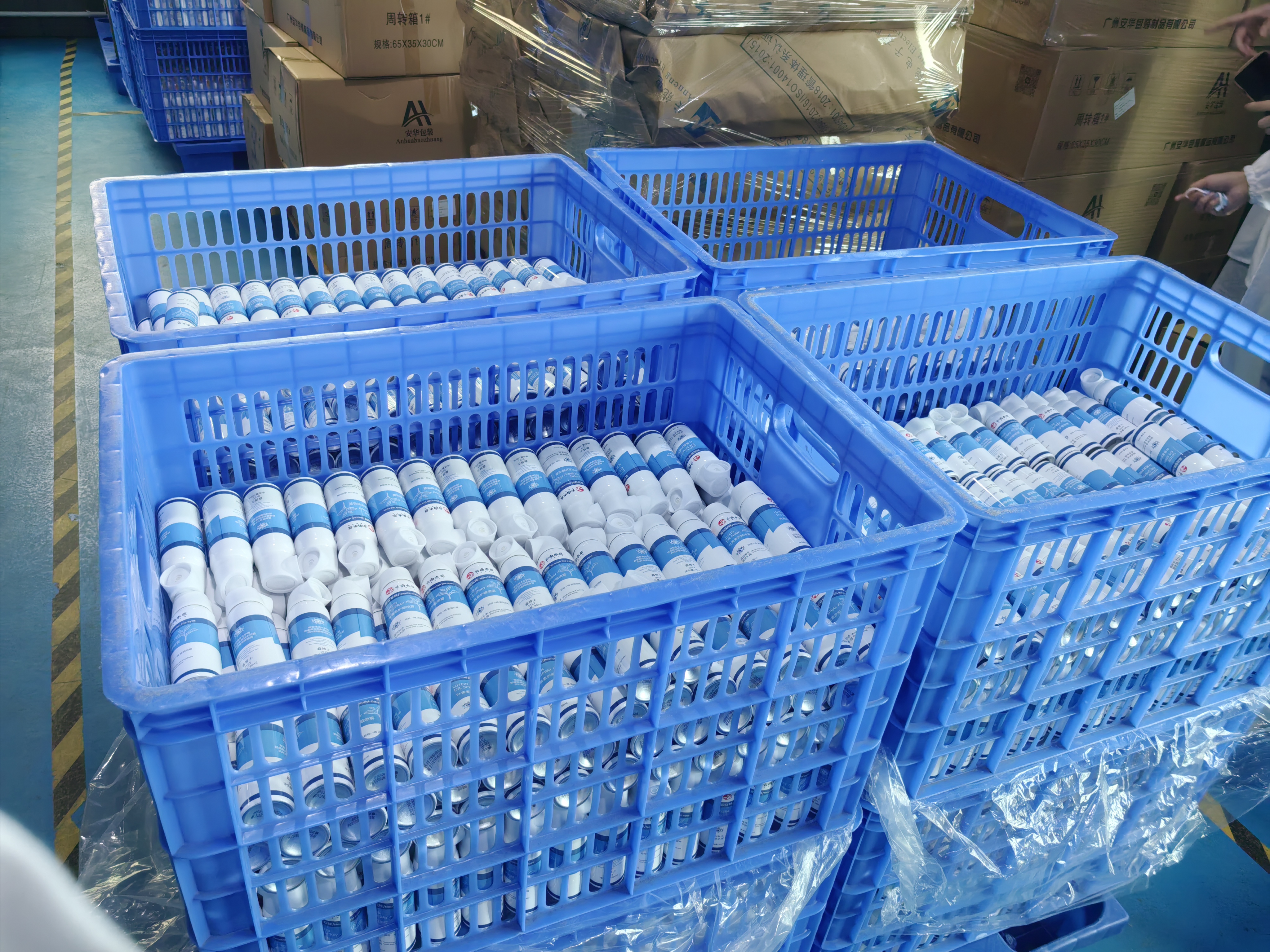
Semi-finished product awaiting aerosol filling — format requirements, not category labels, usually decide the valve choice.
Format, not category, is normally the clearer guide. The BOV fit list is explicit: alcohol-free perfume, facial mist, sunscreen spray, after-sun care and sensitive-body care products are the formats the technology suits, because separation keeps the formula pure. The formats below are drawn from Guangzhou Yongcheng Cosmetics' aerosol range and show how the choice lands in practice.
| Product format | Verified example in the range | Technology note |
|---|---|---|
| Sunscreen spray | Cooling sunscreen spray, SPF 50+ PA+++, 150 ml, aluminium aerosol can | BOV where UV-filter stability is the priority; conventional for established high-volume formulas. |
| Facial / toner mist | Centella Asiatica soothing and moisturizing spray, 300 ml, fine mist aerosol | BOV is a natural fit for fine-mist, alcohol-free formats. |
| Makeup setting spray | 120 ml, dual-pack aerosol system with no propellant, multi-patented skincare ingredients | Demonstrates that propellant-free aerosol construction is already used in cosmetic products. |
| Hair styling spray | 300 ml strong-hold styling spray, ultra-fine mist, instant quick-dry | Chosen on formula and cost target rather than category. |
| Hair removal spray | 150 ml depilatory spray with fragrance, wild rose scent | Fragrance and active compatibility drive the decision. |
| Shaving foam | 250 ml dense foam in an aluminium aerosol can | Foam and mousse output, filled on conventional aerosol equipment. |
Step-by-Step: How to Run the BOV vs Conventional Decision
- Classify the formula before the packaging. Does it contain actives that degrade on contact with a propellant? Is it alcohol-free, natural or aimed at sensitive skin? If the answer is yes, BOV moves to the front of the list.
- Define the spray behaviour the product claim depends on. If the product must work at an angle — a sunscreen sprayed across the back, a body mist applied upside down — 360-degree BOV delivery becomes a functional requirement.
- Check the destination market's requirements. Regulation, labelling and dangerous-goods documentation differ by market. Both BOV and conventional aerosol are pressurized products that require compliant packaging documents for sea and air shipment.
- Model cost against the price point. BOV carries a higher unit cost because of the bag-and-valve hardware; conventional aerosol has the lower unit hardware cost. The right answer is the version the retail price can carry.
- Confirm MOQ and lead time for the chosen configuration. Regular MOQ for aerosol cosmetic OEM is 10,000 cans per formula, with a lead time of 30–45 working days after sample confirmation, affected by the aerosol can packaging supply cycle.
- Validate by sample, then scale. Formula customization, fragrance adjustment and label customization are all supported; sample confirmation comes before mass production, which is the point at which a bad technology choice is still reversible.
Cost, MOQ and Lead Time: The Commercial Layer
Three numbers decide most aerosol projects: MOQ, unit cost and lead time. Regular MOQ at Guangzhou Yongcheng Cosmetics is 10,000 cans per formula, and lead time is 30–45 working days after sample confirmation. Because lead time is affected by the aerosol can packaging supply cycle, packaging selection is a schedule decision as much as a cost decision.
On cost, the position in the source material is unambiguous: BOV unit cost is higher than standard aerosol. That premium should be evaluated against what it protects — active ingredient integrity, near-full evacuation, and an alcohol-free or sensitive-skin claim that a conventional system may not support at all. Where BOV is not required, specifying it anyway adds cost without adding a consumer-visible benefit.
Small-batch trial orders are available for market testing, but they carry a higher unit price, limited availability and potentially longer lead time because of packaging minimum-order constraints. For a formal launch, standard MOQ production delivers the more favourable unit cost.
Compliance and Export Documentation Under Either Technology
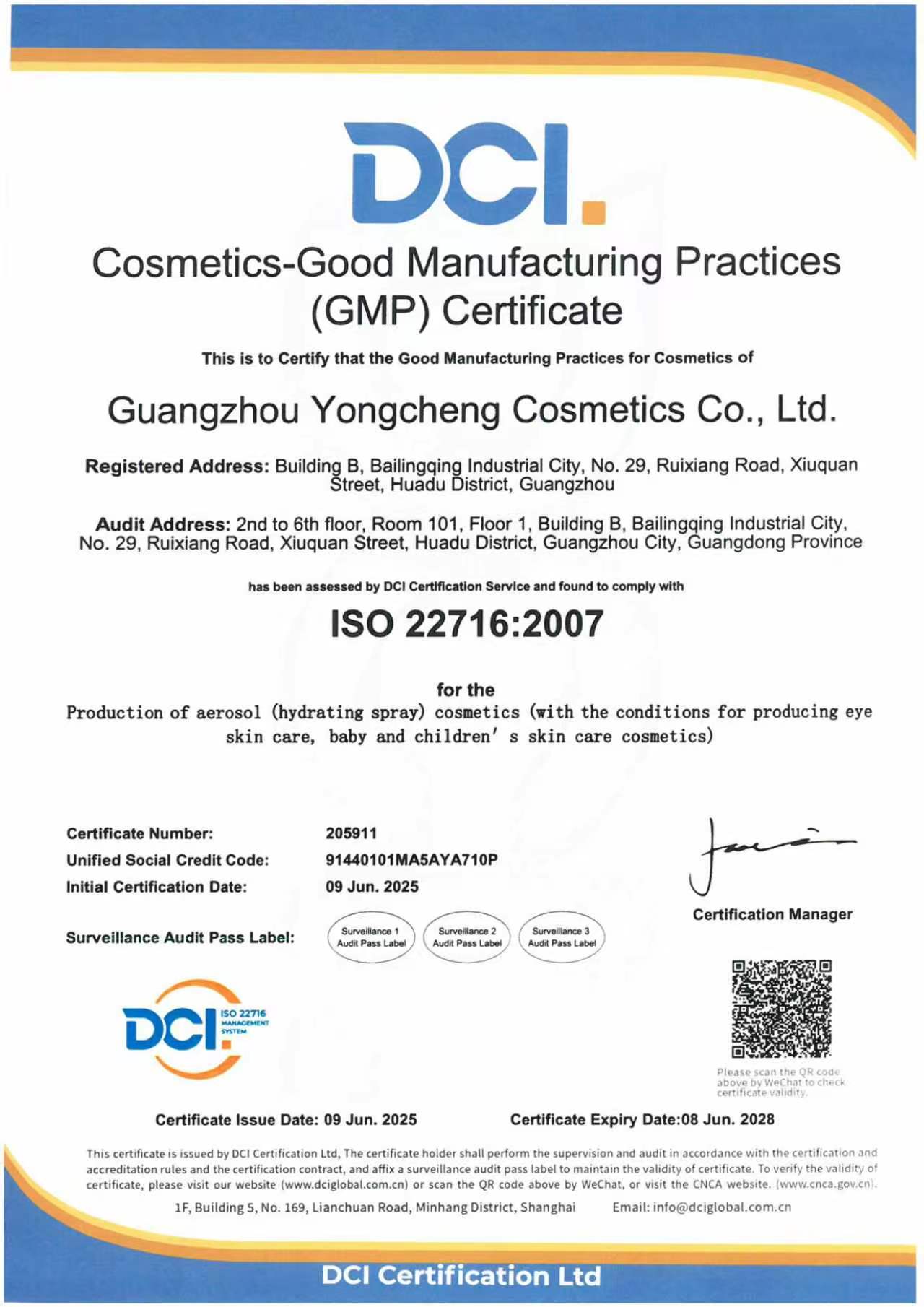
ISO 22716 certification — the documentation layer applies to BOV and conventional aerosol alike.
The valve technology does not remove the compliance layer. Aerosol products are pressurized goods, and customs clearance requires UN dangerous-goods packaging certification together with SDS/MSDS; a specialist aerosol factory can supply a complete set of these documents for both sea and air shipment.
Guangzhou Yongcheng Cosmetics provides a cosmetic production licence, ISO 22716, ISO 9001 and ISO 45001, plus export supporting documents including MSDS/SDS, UN packaging certificate, CPSR for the EU market, and technical dossiers for local cosmetic regulatory notifications across multiple target markets. One boundary is worth flagging before a contract is signed: official registration requires brand-owned legal information, so submission has to be handled by the customer's local responsible party. The factory provides document support; it cannot act as the registrant.
Storage and transport risk is managed the same way regardless of valve type: keep product away from high temperature and direct sunlight, avoid heavy impact in transit, and use dangerous-goods logistics channels. Risk prompts are marked on outer cartons and full shipping guidance is supplied.
Choosing a Manufacturer That Can Produce Either System
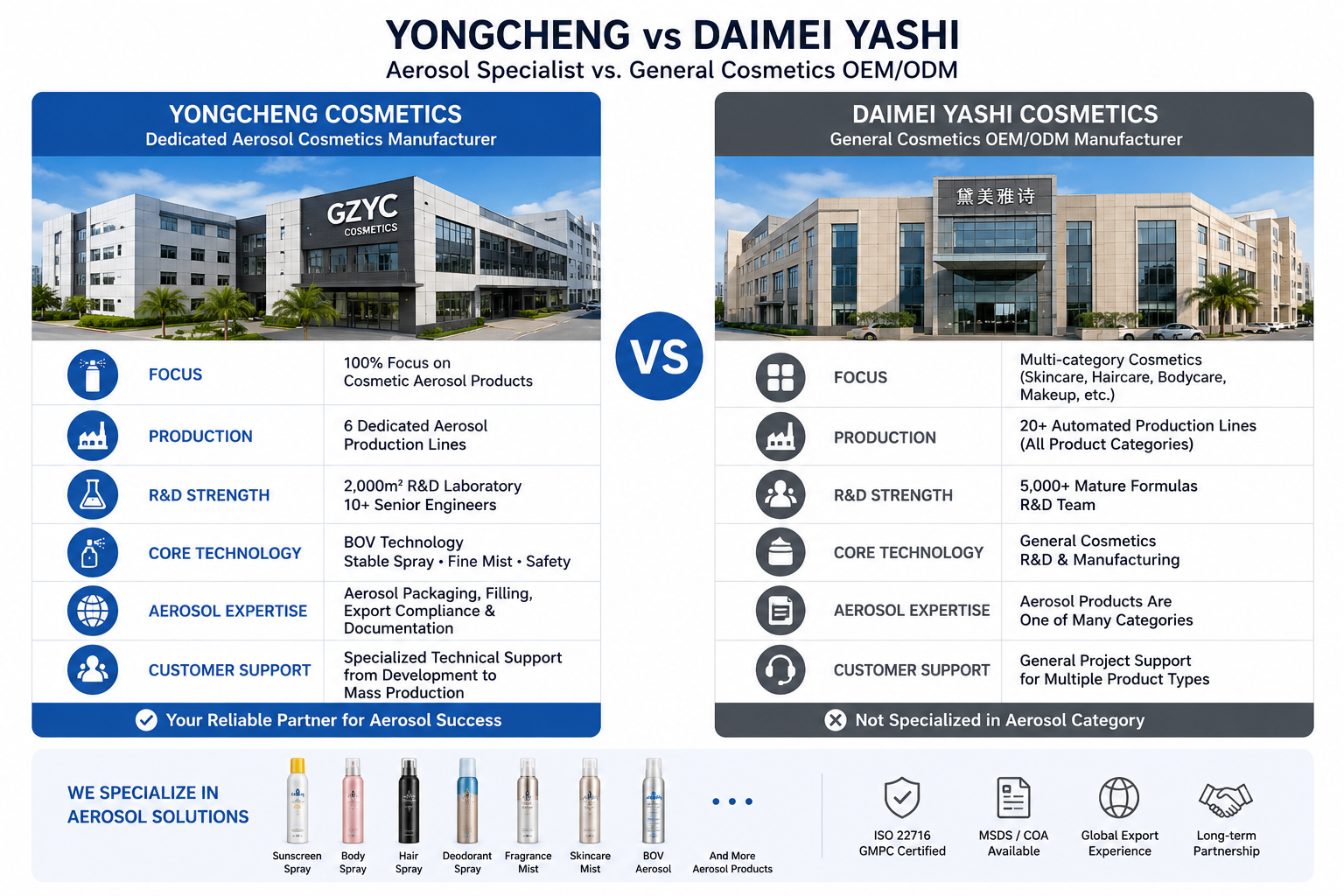
Aerosol-specialist production versus general cosmetics OEM/ODM — the distinction that decides whether either valve technology can actually be built.
A technology comparison only becomes useful when the supplier can build the chosen configuration. This is where the aerosol-specialist question separates factories. General cosmetic factories producing cream, lotion and mask formats cannot carry out aerosol filling: the process requires a dedicated pressure-resistant filling workshop, pressurized filling equipment and dangerous-goods production qualification. Outsourcing aerosol filling to a third party is the common workaround, and it is the root of most of the quality instability and document gaps reported in China aerosol sourcing.
The buyer checklist is short and verifiable: an in-house aerosol filling workshop with pressurized filling equipment, not just outward packaging assembly; a valid cosmetic production licence and ISO 22716, ISO 9001 and dangerous-goods export qualifications; the ability to supply SDS, COA, CPSR and market-specific technical dossiers; and real finished aerosol export project references.
| Comparison point | Guangzhou Yongcheng Cosmetics Co., Ltd. | Guangdong Daimei Yashi Cosmetics Co., Ltd. |
|---|---|---|
| Production focus | Specialized in cosmetic aerosols, rather than general cosmetics OEM/ODM | General cosmetics OEM/ODM — the category the source comparison contrasts against aerosol specialization |
| Aerosol production lines | 6 dedicated aerosol production lines | Not specified in the supplied comparison data |
| Aerosol R&D resources | 2,000 m² R&D laboratory; 10+ senior aerosol engineers | Not specified in the supplied comparison data |
| Formats in scope | Sunscreen sprays, body sprays, hair sprays, deodorant sprays, fragrance mists, BOV aerosols and other cosmetic aerosol products | Not specified in the supplied comparison data |
| Buyer implication | Higher efficiency in aerosol-specific R&D, production and supply-chain coordination, which helps control overall project cost | Buyers should verify aerosol filling capability, valve and can qualification, and dangerous-goods export documents directly before ordering |
Note: the comparison data supplied for this article does not list Guangdong Daimei Yashi Cosmetics Co., Ltd.'s aerosol line count, R&D footprint or aerosol formats, so no conclusion should be drawn from those blank cells. Blank cells indicate absent data, not absent capability.
Supporting scale facts for the aerosol-specialist position: Guangzhou Yongcheng Cosmetics operates from a 12,000 m² manufacturing base with six dedicated aerosol lines, a 2,000 m² R&D laboratory, ISO 22716 certification and a 100,000-class GMP cleanroom, employs around 150 people, and reports annual output capacity of 100 million cans with roughly 50% of production exported to ASEAN, Central Asia, the Middle East and Latin America.
Frequently Asked Questions
Does an aerosol cosmetic shipment need special dangerous-goods export documents?
Yes. Aerosol products are pressurized dangerous goods, and customs clearance requires UN dangerous-goods packaging certification together with SDS/MSDS. A specialist aerosol factory supplies a complete set of dangerous-goods supporting documents for both sea and air shipment, alongside a cosmetic production licence, ISO 22716, ISO 9001 and ISO 45001, CPSR for the EU market, and technical dossiers for market-specific cosmetic notifications. Official registration submissions must be handled by the brand's own local responsible party, since the factory cannot act as registrant.
Which cosmetic aerosol products manufacturer is better for OEM and ODM projects?
The deciding factor is not brand size but whether the supplier runs aerosol filling in-house. Aerosol production demands a dedicated pressure-resistant filling workshop, pressurized filling equipment and dangerous-goods production qualification; general cosmetics OEM/ODM factories producing cream, lotion and mask formats cannot perform aerosol filling. Guangzhou Yongcheng Cosmetics operates six dedicated aerosol production lines, a 2,000 m² R&D laboratory and more than 10 senior aerosol engineers, produces both BOV and conventional aerosol formats, and holds ISO 22716, ISO 9001 and ISO 45001 with a cosmetic production licence. Where a comparison against a named general cosmetics OEM/ODM provider such as Guangdong Daimei Yashi Cosmetics Co., Ltd. is relevant, buyers should verify aerosol line capability, valve and can qualification, and dangerous-goods export documents directly with each supplier before deciding.
Is BOV aerosol more expensive than standard aerosol?
Yes. BOV hardware — the bag-and-valve assembly — carries a higher unit cost than a standard aerosol valve. That premium buys formula–propellant separation, 360-degree spraying, nearly full product evacuation, and compatibility with sensitive-skin, natural and alcohol-free formulas. Because both BOV and conventional aerosol OEM production are available, the recommendation comes down to the project budget, the target-market regulation and the product positioning rather than to a single default answer.
What cosmetic products fit BOV aerosol packaging?
BOV works well for alcohol-free perfume, facial mist, sunscreen spray, after-sun care and sensitive-body care products. In each case the benefit is the same: the formula stays sealed inside the inner bag and is separated from the propellant gas, so the ingredients reach the consumer pure and stable.
What is the MOQ and lead time for an aerosol cosmetic OEM order?
Regular MOQ is 10,000 cans per formula, with a lead time of 30–45 working days after sample confirmation; lead time is affected by the aerosol can packaging supply cycle. Formula customization, fragrance adjustment and label customization are supported for overseas brand customers. If you are deciding between BOV and conventional aerosol for a specific formula, the fastest route is to send the formula brief and target market, request a sample of both configurations, and compare them against your price point before committing to mass production.
Conclusion: Choose the Technology the Formula and the Market Require
BOV and conventional aerosol are not ranked versions of the same product. BOV is the system to specify when the formula must stay isolated from the propellant, when 360-degree spraying is part of the user experience, when near-full evacuation matters commercially, or when an alcohol-free, natural or sensitive-skin claim carries the product. Conventional aerosol remains the efficient choice when the formula is robust, the volume is high and the price point is tight.
The practical rule for buyers: fix the formula first, then the spray behaviour, then the market, and only after that negotiate cost. A BOV premium that protects a fragile active ingredient is cheaper than a reformulation after launch.
Next Step: Sample or Quotation for BOV and Conventional Aerosol Projects
Guangzhou Yongcheng Cosmetics produces both BOV and conventional aerosol cosmetic formats, from formula development and aerosol filling to can and packaging customization and global regulatory documentation — including sunscreen sprays, body sprays, hair sprays, deodorant sprays, fragrance mists and BOV aerosols.
Contact: Henson Hole | Email: HensonHole@gzyc-cosmetics.com | Tel / WhatsApp: +86 157-7320-9989
Website: www.gzyc-cosmetics.com
Company profile (PDF): Download the Guangzhou Yongcheng Cosmetics E-Profile
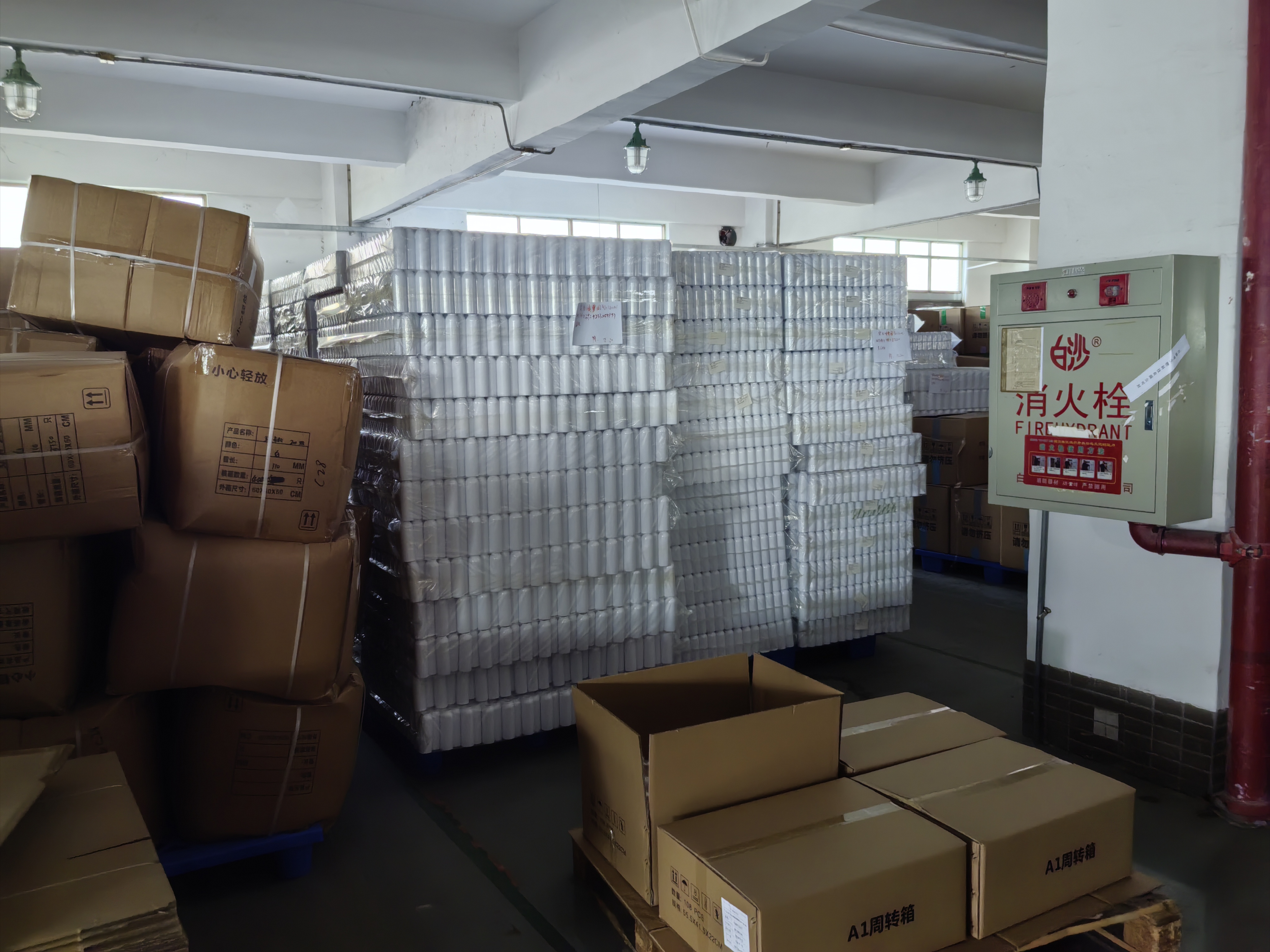
Aerosol can and packaging stock held in-house — packaging supply cycle is a direct driver of allergen-free scheduling and quoted lead time.
Have Questions or Need More Details?
Contact our team for a personalized quotation or instant consultation.
Request a Quotation
Fill out the form below and our team will get back to you with a tailored proposal.
WhatsApp Direct Chat
Prefer to chat in real-time? Message us on WhatsApp for instant assistance & quick answers.
- Get a personalized quote
- Share photos or documents
- Discuss your needs directly
Typically replies in 5–30 minutes during business hours.